Showing posts with label Serbia. Show all posts

Sunday, March 28, 2021

Children's Books, Serbia

I don't know about you, but I love children's literature even though it's been decades since I belonged to that age group. But there is something so beautiful in it, something so unspoilt and pure, that you rarely, if ever see in the books for the older generations.


The first of this kind that comes to mind is "The Little Prince". I'm pretty sure that if at least not everyone has read it, that everyone has heard about it. A book that was on the mandatory reading list in the fourth grade, that equals to being 10 years old. A book I really hated back then cos I couldnt understand it, it was so odd and incomprehensible to my 10 year-old-brain. A book I read again around 10 years later and fell in love with it. To this day I still dont know why,, even though it is considered as a children's book, it is put on the reading list at such young age - I just really dont think that brain can get fully immersed in its beauty. 

Another delight of a book (that I read in my adult years) is The Secret Garden by Francis Hodgson Burnett - if you haven't read it, I really really recommend it - sometimes it takes me by surprise how much of what is considered to be children's literature, is so suitable for adults as well.


And while I'm at it - Neil Gaiman's Coraline is another lovely example to add here :)


In 2010, the theme for the EUROPA's stamps was Children's Books, and Serbia issued these lovely stamps and FDC. A number of titles are hidden in the drawings - can you name them?


And if there is a children's book you'd recommend, please do so - I'd love to read it!


Before I take you to the other children-related posts for today, here is what Serbian post had to say on the subject of Children's Literature:


-Children's Literature singles out as a special literary layer from the aspect of its function and the reader's age. Its main characteristics is belonging to an age where personality is being shaped. The spirit of this particular form of literature is impregnated by signs that are characteristic for childhood: freedom, illusory understanding of live and environment, joy, game, basicness, simplicity, liveliness, etc. Its world is ennobled by joyous charms and composed of fine threads of children's spirit. The main trait of this literary branch is actually one of the decisive roles in child's life. We are here talking about the implementation of beauty, goodness and strength into their spirit: about the art of awakening the curiosity of young minds, learning how to embrace the world with love, and to release the accumulated emotions. The little reader is a young creature who comprehends the world in a different manner and by laws of a different logic. It contemplates and experiences the world though his dreamer's eyes.

The aroused imagination leads the child towards unreachable heights and develops its sensibility. As a driving force of children's discovering of the world, the imagination represents the most powerful means for introducing them into life.

The fame of dream and reality, impossible and supernatural is receptive to the heart of the little reader. The wild and bold imagination broadens its perspectives, frees its thoughts, forms its emotions, enables the comprehension of reality, conjures up to the unknown and invisible, and makes possible the identification with literary heroes.

The imagination creates a new world over which reign other laws of man and nature. 


Check out the other posts here 

Sunday, February 4, 2018

The 75th Anniversary of Belgrade Zoo, Serbia

Good Day Sunday Stampers and anyone else who might have just stumbled upon today's post. Today we are about to close the circle of the first A-Z edition, with a letter not so popular among word games, but one that would actually bring you a huuuge amount of points if you play 'scrabble' or 'words with friends' etc. Reminds me I should get back to some of those words' games and give my brain cells some additional exercise...

Anyways, I had a few ideas in mind for today's Z, and none of them actually related to Zimbabwe, or Zambia, or Zanzibar (isn't it strange though how all these Z places are situated in Africa?)

So instead of countries, here I have a post with two FDCs issued on 12 July 2011, commemorating the 75th anniversary of the Belgrade Zoo.


The Belgrade Zoo originated in 1936 and was founded by Mr. Vlada Ilić, industrialist and mayor of that time. The plans for the zoological garden were drawn up by the engineer Aleksandar Krstić, creator of many buildings and parks in Belgrade those days, who was also the first acting director of the Belgrade Zoo.
At the beginning, the Garden occupied a surface of a little bit more than three and a half hectares while today, after several transformations, it lies on the surface of seven hectares which are located on one part of the Belgrade Fortress, on Kalemegdan, the biggest and most beautiful park in Belgrade (Havent seen all the parks in Belgrade but I do agree this one is beautiful). All the facilities dedicated to the animals are newly built or fully renovated. The garden owns numerous animal species, of more than 2000 animals from 270 different animal species. In addition to many exotic flowers and other vegetation, the Garden also consists of some rare tree species like the Empress tree, Gingko biloba, Picea omorika, Sequoia, etc.
Along with a large number of institutions worldwide, the Belgrade Zoo Garden participates in the programmes for protection and reproduction of endangered animal species. Among many others, some really rare animals are being born and cared for in the Zoo. Some of them are represented on the stamps of this issue, like the Bengal Tiger, the Egyptian Vulture, the Bennett's wallaby, and the White Lion). Here should also be mentioned the Palm Cockatoo, the Griffon Vulture, the Goffin's Cockatoo, the Black Leopard etc.
Nowadays, the Belgrade Zoo represents a real oasis of beauty in the middle of the capital, a respected and modern institution of which this country can be proud and which worthily represents the city and the country across the world. Therefore you should listen to their slogan: "Escape from the city to the centre of the city. Escape for at least a while, from the everyday worries and problems, and spend with us an unforgettable day"  

I have had the chance to visit this place, and I know that many people would say, a Zoo is a Zoo, what can be so different about this one, but I do believe it is worth it to pay a visit. And the ticket price for such a place fairly cheap, around 4 euros. It is funny when I hear some people complaining it is expensive....

That would be all for today. For more Zzzzzzz stuff, visit today's edition of Sunday Stamps.

Sunday, January 7, 2018

Christmas, Serbia

Merry Christmas to you all celebrating it today, me included!

And isn't there a better way (read excuse) to start the posts in 2018 than with something Christmassy related :)


Issued a bit way too early in the year (seriously, who issues Christmas stamps at the beginning of October?!)... but then again when I went to Belgrade last October, they were already putting up Christmas decorations, so this should come as no surprise I guess... Anyways, it definitely is a lovely issue, and that is coming from someone who is really not fond of Christmas and stuff - but this issue rocks, esp. that gingerbread-house stamp... love it! I've said it before, and I'll say it again, Serbia definitely has one of the best stamp issues, not just at a European level, but in general (unlike Macedonian post on the other hand, but let's not get into it now).

Anyways, Happy holidays to you all, and hopefully see you more often around here.
May this year bring gems and delights in your mailbox!

Hugs to all!

Sunday, June 8, 2014

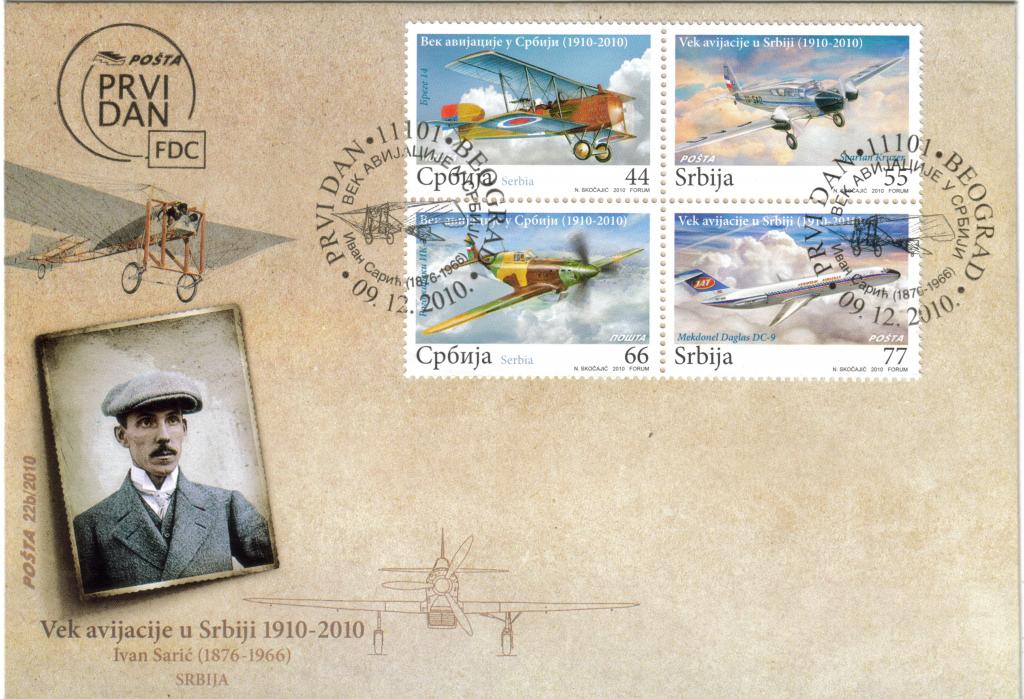
One Century of Aviation in Serbia (1910-2010), Serbia

Time for Sunday Stamps again, with the subject of airplanes, and my contribution are these two Serbian FDC's issued on 09 December 2010, to commemorate One Century of the Aviation in Serbia, as well as a guy named Ivan Sarić (You will read more below)


The idea of flying has haunted man for thousands of years. At the beginning it was just a dream, arisen from a mere human's thought to soar like a bird in the sky.
The pioneers of aeronautics became heroes of their time but also prominent persons of today.

On the stamps above you can see:
- a Breguet 14 (a French biplane bomber and reconnaissance aircraft of World War I)
- a Spartan Cruiser ( a 1930s British three-engined transport monoplane for 6 to 10 passengers built by Spartan Aircraft Limited at East Cowes, Isle of Wight.)
- The Rogožarski IK-3 - a 1930s Yugoslav low-wing monoplane single seat interceptor fighter with retractable landing gear, and was designed by Ljubomir Ilić and Kosta Sivčev as a successor to their IK-1/IK-2 fighter
- McDonnell Douglas DC-9 - a twin-engine, single-aisle jet airliner that was first manufactured in 1965 with its maiden flight later that year. The DC-9 was designed for frequent, short flights


The first among the first was Ivan Sarić (1876 - 1966) whom you can see on both FDCs (and on the latter on the stamp as well), sportsman, enthusiast and constructor from Subotica (town in northern Serbia). Since his first meeting with the aviation, his sports spirit completely devoted to the idea of conquering the last unresearched area on Earth. With a great elan and modest technological knowledge, he builds an airplane, based on his own construction plans. Intuitively, and with great luck and courage, already in the summer of 1910, he accomplished the first successful flights on the racetrack of Subotica. Gradually, he learns the techniques of piloting. On 16th October 1919, he had his first public performance in front of 7000 spectators.
With this accomplishment, made over 100 years ago now, Ivan Sarić has given Serbia the chance to celebrate the Centenary of Aviation, a jubilee of national importance, which just a little number of states in the world can be proud of.
On these laid foundations, a small country elevated aeronautics to an enviable level of development. During the decades that followed, the aviation proved itself to be one of the bearers of state's prosperity.

for more world-flights, click on the big button below

Sunday, January 5, 2014

Sochi 2014 and other Olympic Games

Well, first of all, Happy Holidays to everyone! Hope the year ahead brings you love, joy, happy moments and, of course, lots of great mail :)
Been a while since I participated in the Sunday Stamps, but the entire year of 2013 was slow in general when it came to postcards, letters, blogs' updates...I am not into making New Year resolutions, but I do want to make 2014 a much better one mail-wise...
Today's Sunday Stamps' topic is about Sochi 2014, and other Olympic Games...and having this lovely envelope with the first day cancellations issued by the Russian post, I just couldn't resist participating...and I hope this will be a good start for taking part in as many Sunday Stamps' posts as possible =)


The event shall take place from 6 to 23 February 2014, in the Russian town of Sochi with some events held in the resort town of Krasnaya Polyan. On the envelope you can see the 3 Olympic mascots (the Amur Leopard, the European Hare and the Polar Bear).
I used to be much more into watching this kind of events when I was younger, but now, I barely watch TV and just follow sports online mainly...when Rafael Nadal is on court =)
Macedonia is going to have 3 representatives in this event, one in Apline skiing (men), and two in Cross-country skiing (men and women).
Not having any high hopes, knowing the conditions and the support Macedonian sports men and women get here, but I do wish they do have some great achievements which may open some doors for them in the future =)

Well, the main theme for today IS Sochi indeed, but it does open room for some other Olympic stamps so I decided to include two more (despite that as a general rule I do not include more than one country per post, unless it is some joint issue)

this second envelope is from Hong Kong with one fantastic mini sheet issued on July 27, 2012 to commemorate the 30th Olympic Games, released on day one of the London Games. These stamps form an exuberant circle that is bursting with sporting action.


the last one is a Serbian FDC, commemorating the XXI Olympic Winter Games that were held from February 12-28, 2010 in Vancouver, Canada.
Boy, it seemed as if this event in Vancouver took place just last year, but four years have passed indeed since then! Time simply flies so fast =/


well, I hope you liked my choice for today =)
See what others have picked, by clicking on the big button below


Sunday, November 3, 2013

Preserve the Polar Regions and Glaciers, Serbia

this Sunday Stamps' theme is Arctic and Antarctic...and by some sort of inertia I went looking for Polar Glaciers...and then I was, but wait, how can I be sure if this is actually portraying the Arctic or Antarctic...I mean, you have glaciers in Patagonia as well...but well, I decided to interpret this a bit broadly =)


so here I am happy to present this Serbian FDC issued in 2011, on the topic of "Preservation of the Polar Regions and Glaciers".
Sometimes I find it funny that countries like Serbia for example, issue such 'polar's stamps...I mean, it may have somewhat like polar temperatures during winter, and I know that the so-called global warming is a global issue indeed, but still...I am not complaining, on the whole contrary...Serbia has such fantastic stamps that it is a pleasure to own this cover...I just never found the logic behind the decisions of issuing some particular themes...on the other hand, Macedonia is not issuing anything...not even Lunar stamps...go figure...

Anyways, this is what the Serbian Philately Service had to say about this issue.

"The Universal Postal Union in Bern is the initiator of a philatelic campaign, which is dedicated to raising awareness of the endangered state of the polar regions and glaciers in this era of global warming.
A glacier, as a product of glaciation is a moving body of ice. The development of the glaciation process occurs on altitudes with negative balance of insolation and radiation. The glaciation process falls into 'climate processes' and its beginning and ending depend on great climate changes - cooling, that is, warming. Those changes occur gradually and very slowly.
There are two main regions of glaciation process - the polar region and the high mountain regions - as well as two main types of glaciers, the continental and alpine. On Earth, 99% of glacial ice is contained within vast ice sheets in the polar regions (Antarctica, Greenland), but glaciers may be found in mountain ranges of every continent except Australia. Ice from the glaciers is the largest source of fresh water on the planet. It is assumed that if polar glaciers and ice sheet (which contain 2.5% of world's water resources), melted, the sea levels would rise up from 0,5 - 2 metres. During the past fifty years, around 7000 km² of ice sheet have desintegrated.
Since the middle of the 20th century, the global warming is a consequence of higher concentration of greenhouse gasses, which has increased as a result of human activities such as the combustion of fossil fuels and deforestation.
The Kyoto Protocol is a protocol toe the United Nations Framework Convention on Climate Change (UNFCCC or FCC) aimed at reducing carbon dioxide and other greenhouse gas emissions. The Protocol entered into force on February 16, 2005. Since June 10, 2001, the Republic of Serbia is a member of the UNFCCC.
On September 24, 2007, Serbia ratified the Kyoto Protocol.

For more penguins, polar bears or anything freezing-cold, click on the button below :)

Sunday, September 29, 2013

Ecology - Balkan Mountain, Serbia/Bulgaria

It is time for another Sunday Stamps' entry...with the theme of birds this time...and here I come to show you these two awesome FDCs I got myself few months ago when I visited Belgrade...in a way, you can say I "robbed" the philately store during my visit :D

Anyways, I am happy to have this opportunity to present this joint issue between Serbia and Bulgaria...I really wonder why WE don't have such awesome joint issues...or why we BARELY have any joint issues in the first place?! The joint issues mean closer cooperation between the postal administrations and exchange o valuable experiences in the field of postal circulation. On this occasion, Serbia and Bulgaria have chosen to portray the Balkan Mountain (or Stara Planina as known in Serbia and Macedonia for example) which belongs to the big Balkan mountain range that runs 530km from the Black Sea, on the East, to the Vrška Čuka Peak on the West and is part of the Carpathian-Balkan Mountain range. The smaller, western part of the mountain is located on the territory of East Serbia. Its highest peak is Botev (2376m) in Bulgaria, while on the Serbian side, the highest peak is Midžor (2169m).
The area of the Balkan Mountain was declared a National Park back in 1997 and is also classified as an area of interstate (Green Belt Programme) and international (Important Birds Areas, Important Plants Areas, Prime Butterfly Areas) etc
The ornithofauna of the Balkan Mountain is very rich and until nowadays (speaking about 2009 here), has 206 recorded bird species, of which 104 are protected by the Bern Convention and the Regulation of the Serbian Government on Natural rarities protection)
The motif of these jointly issued stamps is the Balkan mountains landscape with birds: Scolopax rusticola (Eurasian Woodcock) and Monticola saxatilis (Rufous - tailed Rock-thrush)


The Eurasian Woodcock is 33-38 cm in length, including a 6-8cm long bill. Its eyes are located high on the sides of its head, giving it a 360° monocular vision. Eurasian woodcocks nest on the ground, in low cover in woodland. It feeds by probing in the ground for invertebrates with its long bill. This species has a global population of an estimated 15-16 million birds.

The Rufous - tailed Rock-thrush is a songbird which is regularly seen on the Balkan Mountain. It is a medium sized bird of 17-20 cm in length. This species breeds in open dry hilly areas, usually 1500m above the sea level. In Serbia, its population is estimated to be between 1400 and 2000 individuals, and according to this fact, is considered as a declining species in the country.

And here you have the s/s on the other FDC...it is just awesome, don't you think?


for more birdy stuff today, click on the link below...and have a great Sunday!!


Sunday, February 17, 2013

Year of the Tiger, Serbia

morning/afternoon/evening to all! Here comes another "issue" of the Sunday Stamps post. The theme being Lunar Year and Chinese stamps, I was not quite sure what to post...not that I do not have Chinese stamps...have a lot of those, but was somewhat indecisive...and then I realized I have this lovely FDC my dear Ana sent me some time ago, and it fits perfect into today's subject...I know it is the Year of the Snake now, but I must tell you that Im not really a snake lover...ok, im not at ALL a snake lover, I shudder at the thought of a snake, though the stamps Ive seen issued on the subject are really fascinating :) However, ill still go with the tigers this time :)


I must say that the Serbian postal service is issuing really fantastic stamps, and the Lunar Horoscope ones are not an exception....on the other hand, the Macedonian postal service has not yet issued anything related to this subject, EVER =/ Speaking of that, the philately lady should be back to work the following week, at a different post office though....the one that has undergone the fire is still far from offering normal working conditions...but well, I hope id be able to get some new stamps coz ive been really struggling with it..

bit off-topic..recently I watched "The Life of Pi" - a really nice movie...and if you've seen it, you are familiar with Richard Parker, the tiger appearing in the movie (whether he was a real character or part of Pi's imagination, that is for another discussion). Anyways, Richard Parker in soooooo many ways reminded me of my cat Foxy ...I know it may be crazy, but that look in his eyes, the way he was yawning, or stretching out his paws to fight....as if I have a miniature version of him at home....so since then, Ive started calling my cat Richard Parker too...they are both just adorable :)  Off to give him a pet :)  And you can see what others have picked for today...just click on the button below

Saturday, December 25, 2010

125 Years of the Orient Express, Serbia

A fantastic FDC issued by Serbia on 09.06.2008!!!!


Ive already posted about the Orient Express joint issue between Austria and Romania....but this is what the story behind the Serbian FDC is.

The Orient Express, luxury passenger train which connected West with East Europe, ran for the first time on October 4th in 1883. Its creator, Georges Nagelmackers introduced, on European railways, first luxury sleeping cars and restaurant cars. That was the time when political and economic relations, progressing trade and the beginning of modern tourism resulted in the big augmentation of the number of passengers. However, in those days, long trips by land were very strenuous and unpleasant. That is the reason why trains belonging to Nagelmackers CIWLT company (Compagnie internationale des Wagons - Lits et du Tourisme) achieved very fast a great success and set up new standards for travelling through Europe.
After several long routes, Nagelmackers decided to introduce a luxury train which connected Paris with Vienna, and by them also London and Berlin with countries in the Balkans and the capital of Turkey, Istanbul. Since the railway road through Serbia and Bulgaria was not yet finished, the first Orient Express communicated from Paris to Bucharest where passengers were ferried across the Danube and the Black Sea. This train, still called in those days the "Lightning train", passed through Serbia for the first time on November the first in 1885, reaching Niš which was its terminus. In 1888, when the railway to Sofia was finally finished, the train which, in the meantime, got a new name the "Orient Express", began to run on its direct route to Istanbul. After World War I, actual political relations brought up changes of this train's route. France and England wanted a faster connection with the Balkans and Turkey, so this train shortened its route through the Simplon Tunnel and was named the Simplon Orient Express. This period represents the culmination in the development of this train.
World War II and the political changes that followed significantly influenced the famous train. Damaged tracks and problems on boarders in relation with the Iron Curtain made the journey on the Orient Express problematic. Very soon, airplanes occupied the free space and took over the passengers. The most luxurious European train became an ordinary express train. in 1977, as a pale shadow of the legendary train, the famous Orient Express was withdrawn completely with the last Paris-Istanbul service.
Connecting for decades, on the most luxurious way two worlds, the Orient Express became the symbol of a lifestyle By using it, rulers, politician, rich men, artists, adventurers and spies have magnified its fame.
Immortalized in several literary works and films, the Orient Express is also well known to the younger generation.
For Serbia and other countries in the Balkans, the greatest significance of Orient Express was the highest quality connection to the most developed parts of Europe.

some technical details regarding the two stamps on the FDC:

 Width:          35.0 mm
Height:           29.0 mm
Denomination: 20 CSD/50 CSD
Layout/Format sheet of 8
Perforations:    13.25 by 13.25

Sunday, August 22, 2010

125th Anniversary of the Railroad in Serbia

Seems like there are a lot of 125th railway anniversaries around the world :)


This lovely FDC comes from Serbia, in order to commemorate their 125th railroad anniversary.

The first railways on the territory of Serbia were already built in the middle of the XIX century in Banat which was part of the Habsburg Monarchy at the time. Although the construction of the railway in the Principality of Serbia was already considered, the conditions for it were created just after the Congress of Berlin, in 1878, when the Principality got its complete independence. During this Congress, decisions were made to establish routes which would connect Europe (through Serbia and Bulgaria) with Turkey and Middle East. In accordance with those decisions, on 15th September 1884, Serbia opened its first public railroad route from Belgrade to Niš so that day represents the birthday of the Serbian Railroad. The first train had a steam locomotive CS No.1. This was one of the most important events in the newer history of the country. The railroad route from Belgrade to Niš was the biggest and most expensive project accomplished during the XIX century in Serbia. With the later construction of the railroad system this route had a great influence on the modernization and lifestyle in Serbia, its connecting with European countries, economic development and position in the scope of international relations. Even nowadays, this route as a segment of Corridor X represents one of the most important railways in Serbia and South-East Europe. It is an electrified railroad with modern electric locomotives.
The railroad route Belgrade-Niš is 243,5 km long and is constructed as a narrow-gage railroad with 23 stations. The biggest and most beautiful station buildings were at the time erected in Belgrade and Niš. The building of the Belgrade station has undergone many wars but preserved its beautiful original architecture. The original building of the station in Niš was so damaged, during the Anglo-American bombing in 1944, that it couldnt be renovated. After the many years of use of a provisory building, a new one was solemnly opened in 1973 as one of the biggest and most beautiful in Serbia.

Motifs on the stamps:
- stamp face value 22,00 dinars: the first steam locomotive CS No.1 of the Railroad of Serbia and in the background the building of the station in Belgrade;
- stamp face value 46,00 dinars: electric locomotive series JŽ 441, in the background is the building of the station in Niš.

Date of Issue: 8 September 2009
Stamps' Width: 30.0 mm
Stamps' Height: 37.5 mm
Layout/Format: sheet of 25
Perforations: 13.25 by 13.25

Friday, May 7, 2010

Motoring - 55 Years of "Zastava 750"

A Fantastic FDC from Serbia....which many older people (from this part of the world)  will probably find it sentimental, remembering the good old days, when whole families would pack themselves in this card and drive hundreds of kilometres for their summer vacations....the legendary Zastava 750, or as widely known here, Fićo!


In 1955, in SFR Yugoslavia started the production of "zastava 750", more popular under the name of "fića".
This vehicle was largely derived from Fiat 600 D, which had at first an engine of 633 cc, and later of 767 cc with 23 to 27 HP.
Although intended for the transportation of smaller passengers on shorter distances, whole families have used it to travel from one side of the country to another, in order to visit their relatives.
Some time earlier, Fiat's general engineer. dr. Dante Giacosa (1905-1996), got the task to construct a small vehicle which would enable comfortable driving  of four passengers. He succeeded to create the Fiat 600, which was, according to many, the most successful and most popular Fiat of all times. Shorter than his predecessor for 130 mm, this Fiat was a miniature four-seat vehicle with two doors. It had a four cylinder engine of 633 cc with 16kw, placed behind the rear axle, with an independent shock absorber setup on all wheels. The whole vehicle weighed only 585 kg.
Fiat 600 instantly won the hearts of many drivers so that five years after the car's launch, the millionth "600" was produced.
Definitevly "fića" had a crucial role in the Yugoslavian motoring. This car was used as a police car, an ambulance, for military needs, and in driving centres. In April 2000, at the Motor Show in Belgrade, "zastava 750" (the popular "fića"), was declared to be the car of the century and millennium, according to the opinion of the Serbian drivers.

Well, you know what they say, Best things come in small packages :)))))))))))
Our family never had a fićo....and i feel like i am missing a great part of history coz of that.
Even nowadays in the streets here, you can see these cars on the street...people who have them, often cant give them up....sentiments :)