Showing posts with label India. Show all posts

Sunday, June 14, 2020

Brides in traditional costumes, India

I almost did a wrong theme today, that is, I almost did a future post two weeks ahead and was trying to find something suitable for anniversaries.

Then I went over to Sunday Stamps to check if and what others have posted, in order not to overlap ... and I was seeing fireworks... got me a bit confused... ok, there may be fireworks when commemorating some anniversary, but still, something didn't click right... and of course it wasnt right when I have misread the topic... at least I figured it out in time 😎


So, to make this topic right, I have this FDC from India, with these four stamps issued almost 40 years ago, on 30.12. 1980, showing different bridal traditional costumes, from different Indian regions, namely, Kashmir and Bengal in the top row, and Rajasthan and Tamilnadu in the bottom row.

I love these kind of traditional wedding dresses and not the typical bride in white kind of thing. It is amazing to see all the differences not jut in the different Indian regions, but also throughout the world, and it makes me wonder arent all these clothes and accessories sometimes too heavy too wear... imagine it in a hot weather outside.

As a side note, I hate weddings as a celebration in real life, I mean really hate them and am thankful that people have figured that out so often they dont invite me to one, which spares me the agony of going to one, as well as trying to find an excuse of why I cannot go :)  But I can deal with them when they are on stamps :)
How about you? How do you feel about weddings?


For more celebratory stamps, head over to today's edition of Sunday Stamps 

Tuesday, March 29, 2016

Lighthouses of India, India

One of the few beautiful covers I received yesterday from India...


this set of two lighthouse stamps was issued by India Post on 23 December 2012, featuring the Alleppey (face value of Rs 20) and the Mahabalipuram lighthouse (face value of Rs 5).

The Alleppey (or the Alappuzha) Lighthouse is situated in the coastal town of Alappuzha, Kerala. It was built in 1862 and is a major tourist attraction. It has been opened to the public since 2007 and visitors are allowed between 15:00h and 16:30h on weekdays. The admission fee is 10 rupees.


The Mahabalipuram lighthouse is located in Tamil Nadu, and has been opened to tourists since 2011. The first light was commissioned in 1887, while it became fully functional in 1904. It has a circular masonry tower made of natural stone. India's oldest lighthouse, built around 640 AD by Pallava king Mahendra Pallava stands next to this modern structure.

Thanks a whole lot to Jinesh for this one!

Sunday, March 6, 2016

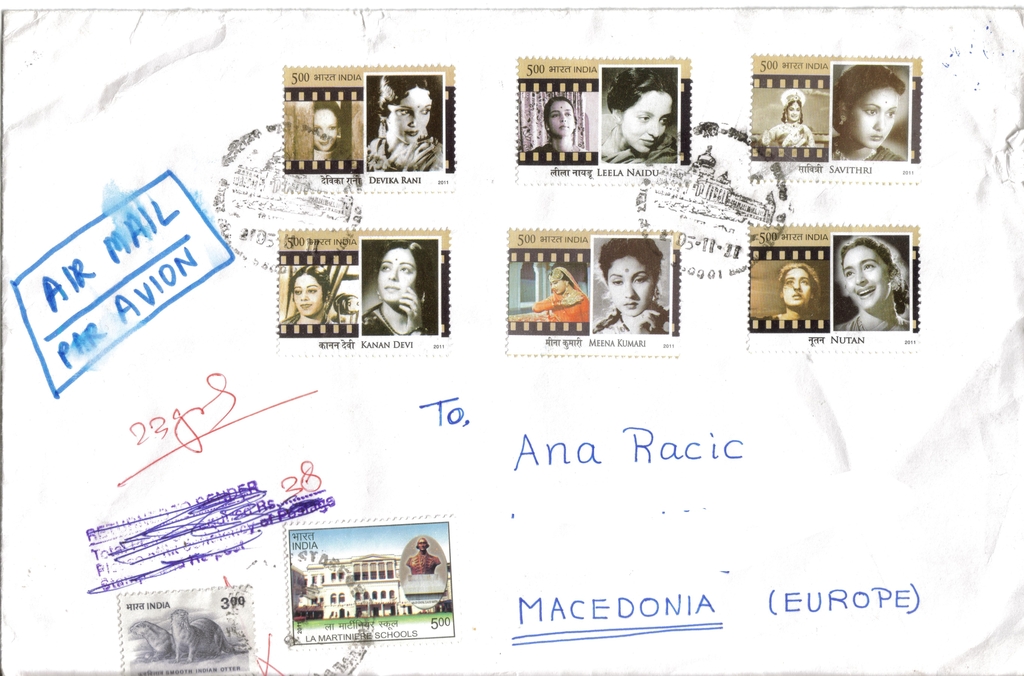
Heroines of Indian Cinema, India

For today's theme on women for Sunday Stamps, I decided to showcase these not so famous ones from India...and for this I chose this cover with a set of commemorative stamps showing legendary heroines of the Indian Cinema...I must admit that the number of Indian/Hindi films is really scarce and this part of the world cinema has been somewhat neglected from my side - I should really do something to change this (and I am not talking here about those Indian soap-operas they used to show here on TV, I am talking about about real great movies here).


First we have Devika Rani, born in 1908 - an actress in Indian films who was active during the 1930s and 1940s. She was widely acknowledged as the first lady of Indian cinema and had a successful film career that spanned 10 years whose persona and roles in films were often considered socially unconventional. Her awards include the Padmashri (1958), Dadasaheb Phalke Award (1970) and the Soviet Land Nehru Award (1990). She died in 1994.


The middle stamp shows Leela Naidu - born in 1940, died in 2009 (and she had died on my birthday! =/)
She starred in a small number of Hindi and English films, including Yeh Raaste Hain Pyaar Ke (1963), based on the real-life Nanavati case, and The Householder, Merchant Ivory Productions' first film. She was Femina Miss India in 1954, and was featured in the Vogue along with Maharani Gayatri Devi in the list of 'World's Ten Most Beautiful Women', a list she was continuously listed from the 1950s to the 1960s in prominent fashion magazines worldwide. She is remembered for her stunning classical beauty and subtle acting style.


The third stamp in the first row shows Kommareddy Savitri (1934 - 1981) - she was an Indian film actress, director and producer. She appeared in Telugu as well as Tamil, Kannada and Hindi language films. In 1960, she received the Rashtrapati Award for her performance in the Telugu film Chivaraku Migiledi.


The bottom row starts with Kanan Devi (1916 - 1992) - an Indian actress and singer. She was among the early singing stars of Indian cinema, and is credited popularly as the first star of Bengali cinema. Her singing style, usually in rapid tempo, was used instrumentally in some of the biggest hits of New Theatres, Kolkata.


The middle stamp shows Meena Kumari (1932 - 1972 - oh, now she had died young....but there seems to be a reason for that) - she was an Indian film actress and poet. She is regarded as one of the most prominent actresses to have appeared on the screens of Hindi Cinema.
During a career spanning 30 years from her childhood to her death, she starred in more than ninety films, many of which have achieved classic and cult status today. She is regarded as one of the geatest Hindi movie actresses of all time.
Kumari gained a reputation for playing grief-stricken and tragic roles, and her performances have been praised and reminisced throughout the years. Like one of her best-known roles, Chhoti Bahu, in Sahib Bibi Aur Ghulam (1962), Kumari became addicted to alcohol. Her life and prosperous career were marred by heavy drinking, troubled relationships, an ensuing deteriorating health, and her death from liver cirrhosis in 1972. Kumari is often cited by media and literary sources as "The Tragedy Queen", both for her frequent portrayal of sorrowful and dramatic roles in her films and her real-life story.


The last stamp shows Nutan Behl (1936 - 1991) - an Indian actress who had appeared n more than 70 Hindi films in a career spanning over four decades. Regarded as one of the finest female actors in the history of Hindi cinema, Nutan was noted for playing unconventional parts, and her performances often received praise and accolades.
She holds the record of five wins of the Best Actress Award at Filmfare, which was held only by her for over 30 years until it was matched by her niece Kajol in 2011; on the overall she is the most-awarded actress in the female acting categories at Filmfare, with six awards alongside Jaya Bachchan. In 1974, she was awarded the Padma Shri by the Government of India.

n.B: Filmfare is one of the oldest film events in India an is presented annually by The Times Group to honour both artistic and technical excellence of professionals in the Hindi language film industry of India.

this set was issued on 13 February 2011.

Thanks a bunch to dear Sauj for sending it to me!

For more women beauties and accomplishments check today's edition of Sunday Stamps.


Sunday, June 22, 2014

Dolphins and Sharks, India-Philippines

Time for Sunday Stamps...and my first ever post written from my backyard! On a sunny day!! Feels so lovely! My dad just installed this roof over our terrace, so now, rain or shine I can sit, eat, work, read...in my backyard, outside in the fresh air! Cannot explain how happy I am cos of this..even work feels more pleasurable now!

Anyways, without any further ado...the theme for today is 'anything you wish' and while checking some of the recent envelopes I have received, my eyes got set on this...a perfect kind of cover for me, so here it comes to see the light of day...


well I must say that I absolutely ADORE ADORE ADORE dolphins!! And my earliest memory of them is this Flipper TV Series. Yeah, I may not have been born when the show was created, but they did show it here years later when I was a kid...and loved it! I have seen dolphin shows, but my absolute dream is one day to swim with dolphins...even the very thought of it gives me this stomach anxiety..I cannot even imagine how i would actually feel once it happens..and I hope it DOES happen one day.
Speaking of sharks....my earliest memory is again from the childhood...with one of those horror shark-related movies...and NO, i would not want to swim with them, though I still do not approve people killing them...unless in actual danger

Anyways, regarding the cover...this is a joint issue between India and the Philippines, issued in 2009, where first of allyou can see the South Asian river dolphin (Platanista gangetica), which is a freshwater or river dolphin found in India, Bangladesh, Nepal and Pakistan.
Besides the dolphin, you can also see the whale shark (Rhincodon typus), which is a slow-moving filter feeding shark and the largest known extant fish species.It is usually found in tropical and warm oceans and lives in the open sea, with a lifespan of about 70 years.

Well, dangerous or not, I do love the cover...and as long as the sharks are on stamps, I feel on the safe side ;-)

For more interesting stamps, click on the button below...and enjoy your Sunday!


Saturday, October 1, 2011

Heritage Railway Stations of India, India

I was a bit doubtful when preparing this update, regarding what to put and what to exclude, but in the end I decided that it would be the best if I just placed all I had regarding this issue....in case you have something additional belonging to it, feel free to contact me :)


and these are the first Indian stamps featured here as well....so Im glad to have the chance to present you this stuff.

As the title says, this issue presents the Heritage Railway Stations of India and consists of 4 stamps, as you can see above...the stations represented are as follows:
- top left corner shows Howrah Station (one of the four intercity train stations serving Howrah and Kolkata) - bottom left corner shows the Old Delhi Station ( the first railway station to be built in Delhi)
- top right corner shows the Chennai Central Station (the main railway terminus in the city of Chennai and home of the Southern Railway and the most important rail hub in South India)
- bottom right corner shows the Mumbai CST Station (is a UNESCO World Heritage Site and historic railway station in Mumbai which serves as the headquarters of the Central Railways. It is one of the busiest railway stations in India, and serves both as a terminal for long distance trains terminating in Mumbai as well as the Mumbai Suburban Railway)


I was happy to receive this Special Cover for this issue, commemorating the Frontier Mail from Bombay to Peshawar via Baroda.

The Bombay, Baroda and Central India Railway (BB&CI Rly) was a company incorporated in 1855 to undertake the task of constructing a railway line between Bombay and Baroda in India. Baroda (Vadodara) was a part of historic BBCl Railway. The first train came to Baroda on 9th January 1861 and the city was connected with Broach and Surat. In 1863 BB&CI Railway completed the Surat-Baroda-Ahmedabad line. Bombay (Grant Road) was connected with Baroda in 864 via Navsari and Bulsar. By 1879 Baroda was connected with Delhi via Palanpur, Ajmer, Jalpur and Alwar. On 5th November, 1951 the BB&CI Railway was merged with the Saurashtra, Rajputana and Jaipur railways to give rise to the Western Railway.

The frontier mail was flagged off on 1st September 1928, from Colaba Terminus, the main station on the BB&CI Railway. It was the first luxurious and prestigious train in the Indian Subcontinent. The radio facility was provided for the first time in a running train in India and it was also the first fastest train of India. After Independence, it is running between Mumbai and Amritsar. The train has now been renamed "Golden Temple Mail".


And Im honoured to have not one, but TWO fantastic FDC copies...since the stamp's arrangement is different, i can freely consider them as different and equally important for my collection!
One arrived as a lovely surprise from Laura, and the other one arrived from Som.


Indian Railways has stood as an emblem of progress spanning over 150 years. In this period, it catalyzed India's industrialization and has emerged as a lifeline of India's development. Some railway structures are monumental in nature representing significant developments in architecture and technology. On 15.08.1854 a train ran from Howrah to Panduah. This Heritage Run is commemorated by the release of a set of four stamps representing four Heritage Railway Stations in India.
A plan for railway in India was first put forward in 1832. In 1844, the Governor-General of India allowed private entrepreneurs to set up a rail system. The first train became operational on 22nd December 1851 in Roorkee. On 16th April 1853, the first passenger train ran between Bori Bunder, Bombay and Thane, covering 21 miles. The rail network then developed rapidly, radiating from Bombay, Madras, Calcutta and Delhi.
Railways in India were patrons of a style that combined the prestige and relevance of train travel with imaginative innovations of engineering. They were designed with grandeur and dedicated to the customer for eternity. Also, the four Metro Stations - Kolkata, Mumbai, Chennai and Delhi were monumental in scale, striking architectural creations of the 19th century, innovatively designed and incorporated local traditions and craftsmanship. They became a focal point of each city. With the coming of the Railways, there came up railway stations, Railway companies vied with each other to build imposing railway station buildings.
In 1853, India's first train should have started from Howrah but the ship bringing the coaches sank in the river Hoogly and the steam locomotive was mis-dispatched to Australia. It opened in 1854 as the first in the East and amongst the first few stations in India, as a temporary tin shed, for just two pairs of trains, a small booking office and one line along a narrow platform. The first train of the East Indian Railway, driven by Joshua Greenbo, ran from Howrah to Hoogly on 15th August 1854, a distance of 24 miles. This led to India's 1st commercial railway goods corridor from Howrah to Raniganj. The present day station became a necessity with increasing number of trains and opening of the Bengal Nagpur Railway from Howrah in 1900.
From humble beginning for just 5 carriages of only one train, Howrah Station now is among the largest railway stations in the world, catering to all major cities in India, handling over a million passengers a day through 23 platforms and over 300 pairs of trains. From within its magnificent archaic structure, huge crowds and the olden day charm of this great monument make this a wonderful destination. It became and still remains a gateway to the entire eastern and northeastern India.
The first imposing heritage station of the Railway's came up with the Victoria Terminus, housing the office of the Great Indian Peninsular Railway Company. This building was started in 1878 and it was completed and thrown open to the public on New Year's day 1888. The ceiling are very high and exude a sense of space and freedom. The magnificent monument was designed by F.W. Stevens. The decorative carved detail was executed by native carvers from models supplied by Mr.Gomez and the students of the Bombay School of Art. The buildings are faced with a light buff coloured Coorla stone with dressings, cornices and moldings in Porbandar and Seoni stones. The total cost of the whole building was about Rs.27 lakhs. All the work was entirely executed by indigenous labour. In quick succession came the large and imposing station buildings at Madras and Howrah. The landmark in Madras Central Station is the Victorian Clock Tower.The Howrah Station has a predominance of arches with a touch of contemporary British architecture and local trappings. Railways came to Delhi with the establishment of the imposing Old Delhi Railway Station constructed in 1867. The building has several Gothic features. The two-story building has deep verandas on both floors and though the original building is in a good condition, many modifications and additions have since been done. Semi-octagonal turrets rise from the corners of the building.

Date of issue: 16 August 2009
Denomination: 5.00 INR (each stamp)
Width             57.0 mm
Height             32.0 mm