The days between Sunday Stamps seem to pass really quickly, so here we are at the second episode of the third season of the A-Z game.
I seem to have quite a lot of B-related stamps, so it was a tough choice, but the final decision fell on this joint issue among Estonia-Lithuanua-Latvia, from 1999, commemorating the 10th Anniversary of the Baltic Chain. On the cover her is the Estonian mini-sheet.
The Baltic Chain (or the Baltic Way) was an uninterrupted 675.5 kilometre human chain uniting the Baltic capitals of Tallinn, Riga and Vilnius, in which two million indigenous people of Estonia, Latvia and Lithuania, then still occupied by the Soviet Union, joined hands to demand freedom and independence.
It was organised by the joint efforts of the three Baltic countries’ Popular Fronts on the 50th anniversary of the Nazi-Soviet pact of 23 August 1939, which served as a basis for the Soviet Union to occupy the Baltic countries in 1940.
The aim of the Baltic Chain was to draw the world’s attention to continuing Soviet occupation of the Baltic countries and emphasised the non-violent nature of the Baltic nations’ struggle for freedom.
675.5 kilmetres... that is so hard to grasp, leaves me in awe at the thought of it and how it had looked in reality.
For more B-related posts, simply click here.
Showing posts with label joint issues. Show all posts
Sunday, August 26, 2018
Sunday, June 22, 2014
Dolphins and Sharks, India-Philippines
Time for Sunday Stamps...and my first ever post written from my backyard! On a sunny day!! Feels so lovely!
My dad just installed this roof over our terrace, so now, rain or shine I can sit, eat, work, read...in my backyard, outside in the fresh air! Cannot explain how happy I am cos of this..even work feels more pleasurable now!
Anyways, without any further ado...the theme for today is 'anything you wish' and while checking some of the recent envelopes I have received, my eyes got set on this...a perfect kind of cover for me, so here it comes to see the light of day...
well I must say that I absolutely ADORE ADORE ADORE dolphins!! And my earliest memory of them is this Flipper TV Series. Yeah, I may not have been born when the show was created, but they did show it here years later when I was a kid...and loved it! I have seen dolphin shows, but my absolute dream is one day to swim with dolphins...even the very thought of it gives me this stomach anxiety..I cannot even imagine how i would actually feel once it happens..and I hope it DOES happen one day.
Speaking of sharks....my earliest memory is again from the childhood...with one of those horror shark-related movies...and NO, i would not want to swim with them, though I still do not approve people killing them...unless in actual danger
Anyways, regarding the cover...this is a joint issue between India and the Philippines, issued in 2009, where first of allyou can see the South Asian river dolphin (Platanista gangetica), which is a freshwater or river dolphin found in India, Bangladesh, Nepal and Pakistan.
Besides the dolphin, you can also see the whale shark (Rhincodon typus), which is a slow-moving filter feeding shark and the largest known extant fish species.It is usually found in tropical and warm oceans and lives in the open sea, with a lifespan of about 70 years.
Well, dangerous or not, I do love the cover...and as long as the sharks are on stamps, I feel on the safe side ;-)
For more interesting stamps, click on the button below...and enjoy your Sunday!

Anyways, without any further ado...the theme for today is 'anything you wish' and while checking some of the recent envelopes I have received, my eyes got set on this...a perfect kind of cover for me, so here it comes to see the light of day...
well I must say that I absolutely ADORE ADORE ADORE dolphins!! And my earliest memory of them is this Flipper TV Series. Yeah, I may not have been born when the show was created, but they did show it here years later when I was a kid...and loved it! I have seen dolphin shows, but my absolute dream is one day to swim with dolphins...even the very thought of it gives me this stomach anxiety..I cannot even imagine how i would actually feel once it happens..and I hope it DOES happen one day.
Speaking of sharks....my earliest memory is again from the childhood...with one of those horror shark-related movies...and NO, i would not want to swim with them, though I still do not approve people killing them...unless in actual danger
Anyways, regarding the cover...this is a joint issue between India and the Philippines, issued in 2009, where first of allyou can see the South Asian river dolphin (Platanista gangetica), which is a freshwater or river dolphin found in India, Bangladesh, Nepal and Pakistan.
Besides the dolphin, you can also see the whale shark (Rhincodon typus), which is a slow-moving filter feeding shark and the largest known extant fish species.It is usually found in tropical and warm oceans and lives in the open sea, with a lifespan of about 70 years.
Well, dangerous or not, I do love the cover...and as long as the sharks are on stamps, I feel on the safe side ;-)
For more interesting stamps, click on the button below...and enjoy your Sunday!

Sunday, September 29, 2013
Ecology - Balkan Mountain, Serbia/Bulgaria
It is time for another Sunday Stamps' entry...with the theme of birds this time...and here I come to show you these two awesome FDCs I got myself few months ago when I visited Belgrade...in a way, you can say I "robbed" the philately store during my visit :D
Anyways, I am happy to have this opportunity to present this joint issue between Serbia and Bulgaria...I really wonder why WE don't have such awesome joint issues...or why we BARELY have any joint issues in the first place?! The joint issues mean closer cooperation between the postal administrations and exchange o valuable experiences in the field of postal circulation. On this occasion, Serbia and Bulgaria have chosen to portray the Balkan Mountain (or Stara Planina as known in Serbia and Macedonia for example) which belongs to the big Balkan mountain range that runs 530km from the Black Sea, on the East, to the Vrška Čuka Peak on the West and is part of the Carpathian-Balkan Mountain range. The smaller, western part of the mountain is located on the territory of East Serbia. Its highest peak is Botev (2376m) in Bulgaria, while on the Serbian side, the highest peak is Midžor (2169m).
The area of the Balkan Mountain was declared a National Park back in 1997 and is also classified as an area of interstate (Green Belt Programme) and international (Important Birds Areas, Important Plants Areas, Prime Butterfly Areas) etc
The ornithofauna of the Balkan Mountain is very rich and until nowadays (speaking about 2009 here), has 206 recorded bird species, of which 104 are protected by the Bern Convention and the Regulation of the Serbian Government on Natural rarities protection)
The motif of these jointly issued stamps is the Balkan mountains landscape with birds: Scolopax rusticola (Eurasian Woodcock) and Monticola saxatilis (Rufous - tailed Rock-thrush)
The Eurasian Woodcock is 33-38 cm in length, including a 6-8cm long bill. Its eyes are located high on the sides of its head, giving it a 360° monocular vision. Eurasian woodcocks nest on the ground, in low cover in woodland. It feeds by probing in the ground for invertebrates with its long bill. This species has a global population of an estimated 15-16 million birds.
The Rufous - tailed Rock-thrush is a songbird which is regularly seen on the Balkan Mountain. It is a medium sized bird of 17-20 cm in length. This species breeds in open dry hilly areas, usually 1500m above the sea level. In Serbia, its population is estimated to be between 1400 and 2000 individuals, and according to this fact, is considered as a declining species in the country.
And here you have the s/s on the other FDC...it is just awesome, don't you think?
for more birdy stuff today, click on the link below...and have a great Sunday!!
Anyways, I am happy to have this opportunity to present this joint issue between Serbia and Bulgaria...I really wonder why WE don't have such awesome joint issues...or why we BARELY have any joint issues in the first place?! The joint issues mean closer cooperation between the postal administrations and exchange o valuable experiences in the field of postal circulation. On this occasion, Serbia and Bulgaria have chosen to portray the Balkan Mountain (or Stara Planina as known in Serbia and Macedonia for example) which belongs to the big Balkan mountain range that runs 530km from the Black Sea, on the East, to the Vrška Čuka Peak on the West and is part of the Carpathian-Balkan Mountain range. The smaller, western part of the mountain is located on the territory of East Serbia. Its highest peak is Botev (2376m) in Bulgaria, while on the Serbian side, the highest peak is Midžor (2169m).
The area of the Balkan Mountain was declared a National Park back in 1997 and is also classified as an area of interstate (Green Belt Programme) and international (Important Birds Areas, Important Plants Areas, Prime Butterfly Areas) etc
The ornithofauna of the Balkan Mountain is very rich and until nowadays (speaking about 2009 here), has 206 recorded bird species, of which 104 are protected by the Bern Convention and the Regulation of the Serbian Government on Natural rarities protection)
The motif of these jointly issued stamps is the Balkan mountains landscape with birds: Scolopax rusticola (Eurasian Woodcock) and Monticola saxatilis (Rufous - tailed Rock-thrush)
The Eurasian Woodcock is 33-38 cm in length, including a 6-8cm long bill. Its eyes are located high on the sides of its head, giving it a 360° monocular vision. Eurasian woodcocks nest on the ground, in low cover in woodland. It feeds by probing in the ground for invertebrates with its long bill. This species has a global population of an estimated 15-16 million birds.
The Rufous - tailed Rock-thrush is a songbird which is regularly seen on the Balkan Mountain. It is a medium sized bird of 17-20 cm in length. This species breeds in open dry hilly areas, usually 1500m above the sea level. In Serbia, its population is estimated to be between 1400 and 2000 individuals, and according to this fact, is considered as a declining species in the country.
And here you have the s/s on the other FDC...it is just awesome, don't you think?
for more birdy stuff today, click on the link below...and have a great Sunday!!
Labels:
2009,
Balkan Mountain,
Bulgaria,
Ecology,
FDC,
joint issues,
Serbia,
Sunday Stamps
Sunday, November 27, 2011
400 years since Rembrandt's birth, joint issue between Netherlands and Germany
here comes a small piece of art for today's Sunday stamps
I picked this cover with the sheet issued in 2006, to commemorate the 400 years since the birth of this great dutch painter and etcher. He was born on 15 July 1606 and died on 4 October 1669.
Im pretty sure you know quite a lot about him, so I wont be holding on to his general life, but will try to explain what's on the stamps here.
the set consists of 5 stamps plus a vignette, containing the information.
all stamps have a face value of 0,39 euros, and this is actually a joint issue between Netherlands and Germany, which has arisen some controversies, esp regarding a 70c stamp of Saskia in the prestige booklet, which the German's found invalid, since he printing - made in the Netherlands - was different from the prinitng made in Germany for the German sheetlets. The Dutch one actually contained the text in German and in some catalogue listings was said to be good for postage only in the Netherlands, which on the overall is rather confusing as to what's what, so i wont go into depth about it here.
Anyways, as for the stamps here, they all show Rembrandt's works. The top left stamp shows us Saskia van Uylenburgh in a pompous dress (Rembrandt's wife). The portrait was done sometime around 1642 and can be found at the Staatliche Kunstsammlungen in Kassel.
The stamp next to it shows a portrait of Titus reading, c.1657-1658 (Rembrant's son) at The Kunsthistorisches Museum (or the Museum of Fine Arts) in Vienna.
The third stamp in that row shows us the painting called "Woman in a doorway", c. 1656-1657, and can be found at the Gemäldegalerie (or the Art Museum) in Berlin.
As for the bottom stamps, the both show etchings, where the one on the left shows us the "Bearded man, in a furred oriental cap and robe", from 1631, which some consider to be a portrait of Rembrand's father. This can be found at the Rijksmuseum in Amsterdam, while the other one shows us the artist's mother seated at a table, c.1629 - 1633, which can again be found at the Rijksmuseum in Amsterdam.
for some more artistic inputs, click on the big button below
I picked this cover with the sheet issued in 2006, to commemorate the 400 years since the birth of this great dutch painter and etcher. He was born on 15 July 1606 and died on 4 October 1669.
Im pretty sure you know quite a lot about him, so I wont be holding on to his general life, but will try to explain what's on the stamps here.
the set consists of 5 stamps plus a vignette, containing the information.
all stamps have a face value of 0,39 euros, and this is actually a joint issue between Netherlands and Germany, which has arisen some controversies, esp regarding a 70c stamp of Saskia in the prestige booklet, which the German's found invalid, since he printing - made in the Netherlands - was different from the prinitng made in Germany for the German sheetlets. The Dutch one actually contained the text in German and in some catalogue listings was said to be good for postage only in the Netherlands, which on the overall is rather confusing as to what's what, so i wont go into depth about it here.
Anyways, as for the stamps here, they all show Rembrandt's works. The top left stamp shows us Saskia van Uylenburgh in a pompous dress (Rembrandt's wife). The portrait was done sometime around 1642 and can be found at the Staatliche Kunstsammlungen in Kassel.
The stamp next to it shows a portrait of Titus reading, c.1657-1658 (Rembrant's son) at The Kunsthistorisches Museum (or the Museum of Fine Arts) in Vienna.
The third stamp in that row shows us the painting called "Woman in a doorway", c. 1656-1657, and can be found at the Gemäldegalerie (or the Art Museum) in Berlin.
As for the bottom stamps, the both show etchings, where the one on the left shows us the "Bearded man, in a furred oriental cap and robe", from 1631, which some consider to be a portrait of Rembrand's father. This can be found at the Rijksmuseum in Amsterdam, while the other one shows us the artist's mother seated at a table, c.1629 - 1633, which can again be found at the Rijksmuseum in Amsterdam.
for some more artistic inputs, click on the big button below
Sunday, May 29, 2011
The 100th Anniversary of the Birth of Mother Teresa (Agnes Gonxha Bojaxhiu)
well, thanks to Viridian, i seem to be focusing on Macedonian stamps more than usual...but I cant help it when the themes are as such...I could go for many other stamps from around the world...but then, there are Macedonian ones which perfectly fit in, and it seems like a great opportunity to represent my country...if I dont, who else will :) Plus I seem to be making my updates on Sunday only...so I grab the opportunity...
and this week's theme is 'people honoured by a stamp for any reason: historical, politician, writer, artist, educator, Nobel prize winner....well I have a plentiful of stamps to show regarding this....but my choice fell on this FDC issues last year...portraying the woman whom Im sure you've all heard of, Mother Teresa.
whats so special about this FDC? well, for starters it is a limited edition...second, it is a joint issue of the post offices in Macedonia, Albania and Ksovo, and as you can see it features all the 3 stamps issued in the respective countries.
The stamps have a value of 100 lekë (Albania), 1 euro (Kosovo) and 60 denars/equal to 1 euro (Macedonia).
As I said, the stamps and FDC were issued last year, in order to commemorate the 100 years since her birth. The stamp size is 31 x 43mm, offset printing technique, comb perforation.
Now, I dont know if there is anything needed to be said about this woman....I think she is famous enough and you know quite a lot about her....but I dont know how many of you actually know that she was born in Skopje, Macedonia, on 26 August 1910? (or in Üsküb, which is the Turkish name for Skopje, since she was born during the time of the Ottoman Empire in our country). So, thats why in a way we consider this woman so close to us...coz even though she was of Albanian ethnicity and Indian citizenship, she actually started her life right here, in my hometown.
Her name Teresa comes due to the fact that when she took her first religious vows as a nun on 24 May 1931, she chose to be named after Thérèse de Lisieux, the patron saint of missionaries, but because one nun in the convent had already chosen that name, Agnes opted for the Spanish spelling Teresa.
Her life as you know was dedicated to charity missions and helping the people in need....and thats one long long endless list, so I wouldnt go into details, otherwise this post would be never-ending...
But it is worth mentioning that in 1979, she was awarded the Nobel Peace Prize, "for work undertaken in the struggle to overcome poverty and distress, which also constitutes a threat to peace." She refused the conventional ceremonial banquet given to laureates, and asked that the $192,000 funds be given to the poor in India, stating that earthly rewards were important only if they helped her help the world's needy.
For those having doubts how to pronounce her real name, Gonxha Bojaxhiu, .....the 'xh' diphthong is pronounced as the 'j' in 'jar' for example...while the 'j' in 'Bojaxhiu' is pronounced as the 'y' in 'yo-yo' or 'yoghurt'...i hope it is not confusing :)
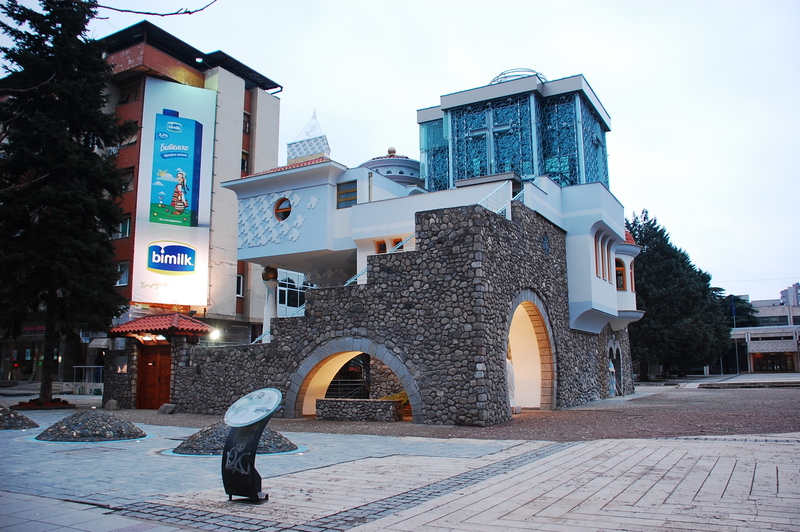
Some years ago, a memorial house was built in the city centre...but if you are asking me, it is one kitschy piece of architecture...and unfortunately, many people here think the same, but who are we to talk about it :)
Anyways, if there are people who'd be interested in this FDC, im sorry I have to say this, but I cant guarantee anything coz of its limited print-out. But I do usually have Mother Teresa postcards in stock, so if someone's interested, you know where to find me.
so, that was my entry for today's Sunday Stamps...to see other famous people portrayed, please click the big button below
and this week's theme is 'people honoured by a stamp for any reason: historical, politician, writer, artist, educator, Nobel prize winner....well I have a plentiful of stamps to show regarding this....but my choice fell on this FDC issues last year...portraying the woman whom Im sure you've all heard of, Mother Teresa.
whats so special about this FDC? well, for starters it is a limited edition...second, it is a joint issue of the post offices in Macedonia, Albania and Ksovo, and as you can see it features all the 3 stamps issued in the respective countries.
The stamps have a value of 100 lekë (Albania), 1 euro (Kosovo) and 60 denars/equal to 1 euro (Macedonia).
As I said, the stamps and FDC were issued last year, in order to commemorate the 100 years since her birth. The stamp size is 31 x 43mm, offset printing technique, comb perforation.
Now, I dont know if there is anything needed to be said about this woman....I think she is famous enough and you know quite a lot about her....but I dont know how many of you actually know that she was born in Skopje, Macedonia, on 26 August 1910? (or in Üsküb, which is the Turkish name for Skopje, since she was born during the time of the Ottoman Empire in our country). So, thats why in a way we consider this woman so close to us...coz even though she was of Albanian ethnicity and Indian citizenship, she actually started her life right here, in my hometown.
Her name Teresa comes due to the fact that when she took her first religious vows as a nun on 24 May 1931, she chose to be named after Thérèse de Lisieux, the patron saint of missionaries, but because one nun in the convent had already chosen that name, Agnes opted for the Spanish spelling Teresa.
Her life as you know was dedicated to charity missions and helping the people in need....and thats one long long endless list, so I wouldnt go into details, otherwise this post would be never-ending...
But it is worth mentioning that in 1979, she was awarded the Nobel Peace Prize, "for work undertaken in the struggle to overcome poverty and distress, which also constitutes a threat to peace." She refused the conventional ceremonial banquet given to laureates, and asked that the $192,000 funds be given to the poor in India, stating that earthly rewards were important only if they helped her help the world's needy.
For those having doubts how to pronounce her real name, Gonxha Bojaxhiu, .....the 'xh' diphthong is pronounced as the 'j' in 'jar' for example...while the 'j' in 'Bojaxhiu' is pronounced as the 'y' in 'yo-yo' or 'yoghurt'...i hope it is not confusing :)
Some years ago, a memorial house was built in the city centre...but if you are asking me, it is one kitschy piece of architecture...and unfortunately, many people here think the same, but who are we to talk about it :)
Anyways, if there are people who'd be interested in this FDC, im sorry I have to say this, but I cant guarantee anything coz of its limited print-out. But I do usually have Mother Teresa postcards in stock, so if someone's interested, you know where to find me.
so, that was my entry for today's Sunday Stamps...to see other famous people portrayed, please click the big button below
Saturday, September 25, 2010
Orient Express, Austria
One great train cover from Edna showing Orient Express!
This is a joint issue between Austria and Romania, in order to mark the special cultural relationships between Bucharest and Vienna, built over time.
This attractive block in the background image shows a map on which the corresponding track is recorded, the Paris Ostbahnhof, the Giant Ferris Wheel and the famous mosque “Hagia Sofia"
The first stamp (which is placed a bit higher on this sheet) represents the Orient Express train in May 1921, at Sinaia station. It had been pulled by a Pacific engine, type 2C1-h4, which belonged to the Bucharest Travelers Depot and was used on the route Bucharest North – Ploiesti – Sinaia – Brasov and back.
The other stamp represents the Orient Express train, in 1909, at Salzburg station, consisted of a four-axle restaurant car and pulled by a compound engine, type 2B-n2v from the Austrian series K.k.St.B. 206.01-206.70 belonging to Depot Wien II and which was used to pull the Orient Express train on the route Salzburg – Vienna and back.
The Orient Express train made the connection between Paris and Constantinople, namely between the Occident and Orient, and was undoubtedly the most famous and romantic of all trains. Though it belongs today only to the nostalgic tourism – by the trains “Nostalgia Istanbul – Orient Express” (N.I.O.E.) and “Venice Simplon – Orient Express” (V.S.O.E.) which ran and continue running through Romania – its echoes have never died away. Writers, musicians, painters and cinematographers got inspired from the history of this famous train and contributed to the creation of its legend.
This train began operating in June 5th 1883, under the name of Le Train d’Orient or Express d’Orient and its first route, Paris (East Station) – Nancy – Strasbourg – Stuttgart – Munich – Salzburg – Vienna – Bratislava – Budapest – Jimbolia – Timisoara – Caransebes – Varciorova – Craiova – Pitesti – Bucharest – Giurgiu – Smarda, 2,638 kilometers long, lasted for 59 hours and 15 minutes. The first Orient Express left Giurgiu for Paris on June 8th 1883, at 13:30, arriving into the capital city at 15:00 and, after a 15 minutes halt, it left on its route to Paris.
The official inauguration of the Orient Express train took place on October 4th 1883; on this occasion, they introduced sleeping coaches with bogies, the first of this kind in Europe. The new cars of Orient Express train had 4 axles, were 17.5 meters long, they were made of Teak wood and had crystal glasses. Heated by steam and illuminated by gas, they were “as comfortable as a luxury suite in Paris”. Between two-axle baggage cars, they introduced two four-axle sleeping coaches, having a 20 seats capacity, and also a four-axle restaurant car. The restaurant car (CIWL 151D) was draped in tapestries from the famous Gobelin manufactories, as well as in Cordoba leather and Genovese velvet; it consisted of a large saloon, a smoking lounge with a library, a boudoir, an office and a kitchen.
Since 1st of June 1889, a second Orient Express train made a direct link between Paris and Constantinople, through a new route via Serbia and Bulgaria, the 2,504 kilometers long course lasting for 67 hours and
35 minutes.
After the commissioning of the Danube bridges, in 1895, the route of the Orient Express train through Romania was extended up to Constanta Harbor on April 19th /May 1st 1896.
During the World War I, the services of the European luxury trains, including the Orient Express train, were cancelled. After the hostilities ended, on April 15th 1919, a new international luxury train called Simplon – Orient Express, was introduced to connect London and Paris via Constantinople. On May 1st 1921, the route of the Orient Express train through Romania was included again in the course, up to Bucharest, via Arad, Teius, Brasov and Sinaia.
The last Orient Express train of the C.I.W.L.T. Company left Paris for Istanbul on May 19th 1977 on the route Paris – Milan – Venice – Zagreb – Belgrade – Sofia – Istanbul (Sirkeci), the entire journey lasting for about 56 hours.
(The cancellation is from the 50 years of OPEC)
This is a joint issue between Austria and Romania, in order to mark the special cultural relationships between Bucharest and Vienna, built over time.
This attractive block in the background image shows a map on which the corresponding track is recorded, the Paris Ostbahnhof, the Giant Ferris Wheel and the famous mosque “Hagia Sofia"
The first stamp (which is placed a bit higher on this sheet) represents the Orient Express train in May 1921, at Sinaia station. It had been pulled by a Pacific engine, type 2C1-h4, which belonged to the Bucharest Travelers Depot and was used on the route Bucharest North – Ploiesti – Sinaia – Brasov and back.
The other stamp represents the Orient Express train, in 1909, at Salzburg station, consisted of a four-axle restaurant car and pulled by a compound engine, type 2B-n2v from the Austrian series K.k.St.B. 206.01-206.70 belonging to Depot Wien II and which was used to pull the Orient Express train on the route Salzburg – Vienna and back.
The Orient Express train made the connection between Paris and Constantinople, namely between the Occident and Orient, and was undoubtedly the most famous and romantic of all trains. Though it belongs today only to the nostalgic tourism – by the trains “Nostalgia Istanbul – Orient Express” (N.I.O.E.) and “Venice Simplon – Orient Express” (V.S.O.E.) which ran and continue running through Romania – its echoes have never died away. Writers, musicians, painters and cinematographers got inspired from the history of this famous train and contributed to the creation of its legend.
This train began operating in June 5th 1883, under the name of Le Train d’Orient or Express d’Orient and its first route, Paris (East Station) – Nancy – Strasbourg – Stuttgart – Munich – Salzburg – Vienna – Bratislava – Budapest – Jimbolia – Timisoara – Caransebes – Varciorova – Craiova – Pitesti – Bucharest – Giurgiu – Smarda, 2,638 kilometers long, lasted for 59 hours and 15 minutes. The first Orient Express left Giurgiu for Paris on June 8th 1883, at 13:30, arriving into the capital city at 15:00 and, after a 15 minutes halt, it left on its route to Paris.
The official inauguration of the Orient Express train took place on October 4th 1883; on this occasion, they introduced sleeping coaches with bogies, the first of this kind in Europe. The new cars of Orient Express train had 4 axles, were 17.5 meters long, they were made of Teak wood and had crystal glasses. Heated by steam and illuminated by gas, they were “as comfortable as a luxury suite in Paris”. Between two-axle baggage cars, they introduced two four-axle sleeping coaches, having a 20 seats capacity, and also a four-axle restaurant car. The restaurant car (CIWL 151D) was draped in tapestries from the famous Gobelin manufactories, as well as in Cordoba leather and Genovese velvet; it consisted of a large saloon, a smoking lounge with a library, a boudoir, an office and a kitchen.
Since 1st of June 1889, a second Orient Express train made a direct link between Paris and Constantinople, through a new route via Serbia and Bulgaria, the 2,504 kilometers long course lasting for 67 hours and
35 minutes.
After the commissioning of the Danube bridges, in 1895, the route of the Orient Express train through Romania was extended up to Constanta Harbor on April 19th /May 1st 1896.
During the World War I, the services of the European luxury trains, including the Orient Express train, were cancelled. After the hostilities ended, on April 15th 1919, a new international luxury train called Simplon – Orient Express, was introduced to connect London and Paris via Constantinople. On May 1st 1921, the route of the Orient Express train through Romania was included again in the course, up to Bucharest, via Arad, Teius, Brasov and Sinaia.
The last Orient Express train of the C.I.W.L.T. Company left Paris for Istanbul on May 19th 1977 on the route Paris – Milan – Venice – Zagreb – Belgrade – Sofia – Istanbul (Sirkeci), the entire journey lasting for about 56 hours.
(The cancellation is from the 50 years of OPEC)
Wednesday, May 26, 2010
Viet Nam
I think that this is not just the loveliest Vietnamese cover I have received, but one of the loveliest covers in general as well.
The initial purpose of the trade was a postcard or more precisely a maxi-card, which i honestly never expected to arrive packed in something like this.
The stamps are from 2008/2009.
The 2008 stamps are the one in the top-right-corner, which is from a joint issue with Singapore, presenting Flora, and here the (in)famous Durian is shown. Regardless of all the stories I had heard about the Durian, I would LOVE to try it.
And the other 2008 stamp is the Olympic one, or the only one which is not put the way it should be. It represents the Olympic Games in Beijing 2008, and this stamp in particular presents the Wushu, which is a full-contact sport derived from traditional Chinese Martial Arts.
Regarding the 2009 stamps, the most present is the Fish one (set of 4 stamps), whose scientific name is Botia Macracanthus, or if you find that hard to remember, you can use its widely accepted name of Clown Loach.
Another 2009 stamp is the Year of the Tiger one (from what ive seen, EXTREMELY popular philatelic topic). It comes in a set of 2 stamps.
And the last one is the stamp with the flower, again coming from a set of 4 stamps.
Thanks Dao!
The initial purpose of the trade was a postcard or more precisely a maxi-card, which i honestly never expected to arrive packed in something like this.
The stamps are from 2008/2009.
The 2008 stamps are the one in the top-right-corner, which is from a joint issue with Singapore, presenting Flora, and here the (in)famous Durian is shown. Regardless of all the stories I had heard about the Durian, I would LOVE to try it.
And the other 2008 stamp is the Olympic one, or the only one which is not put the way it should be. It represents the Olympic Games in Beijing 2008, and this stamp in particular presents the Wushu, which is a full-contact sport derived from traditional Chinese Martial Arts.
Regarding the 2009 stamps, the most present is the Fish one (set of 4 stamps), whose scientific name is Botia Macracanthus, or if you find that hard to remember, you can use its widely accepted name of Clown Loach.
Another 2009 stamp is the Year of the Tiger one (from what ive seen, EXTREMELY popular philatelic topic). It comes in a set of 2 stamps.
And the last one is the stamp with the flower, again coming from a set of 4 stamps.
Thanks Dao!
Labels:
2008,
2009,
cover,
fish,
flora,
joint issues,
Olympic Games,
Viet Nam,
year of the tiger
Subscribe to:
Posts (Atom)