I am a bit late with my entry for this Sunday Stamps' edition, but I was away for the day yesterday and just didn't manage to squeeze this post in, so here comes this post on a cold, gloomy, rainy Monday morning.
I was actually very intrigued to see what people would come up to when it comes to this not so popular letter Q - and I've seen quite some interesting posts.
The first idea that crossed my mind was of course, Qatar, but I only seem to have like one FDC from there, and a rather plain one, so in the end I decided to go with these 3 Polish ones (yeah, Poland again...) regarding the Polish version of the "Quo Vadis" movie.
Issued in 2001, the same year the movie was released (and actually Poczta Polska was the sponsor of the movie, therefore the stamps I guess).
The movie was directed by Jerzy Kawalerowicz, based on the book of the same title by Henryk Sienkiewicz, Quo Vadis: A Narrative of the Time of Nero (1895), which in turn has been made into motion pictures several times. The central plot in the movie revolves around the love of a Roman patrician, Marcus Vinicius, towards a Christian girl (coming from the territory of modern-day Poland) set against the backdrop of the persecutions against Christians during the reign of Nero.
It was Poland's submission to the 74th Academy Awards for the Academy Award for Best Foreign Language Film, but was not nominated.
For the purposes of this post, I decided to watch the movie as well, even though I am not much of a fan of historical movies, plus definitely not ones that last for 170 minutes, and I can now guess why it was not nominated in the end - at times the movie feels like a joke. Good idea - poor execution. Esp the character of Petronius, portrayed by Boguslaw Linda - you can see him on the left stamp below, the guy in the background.
He simply seemed so detached from his character, so out of place in the entire story and all the scenes (I have only seen him in another movie before, the 7th part of the Dekalog series, where he kinda had the exact same attitude in the acting, but I guess in that setting, it suited him more...).
Then there is this scene where Marcus is running through fire - I couldn't tell if they were actually shooting a commercial here about some kind of men's cologne water, or he was trying to save Rome from the fire.
And since I see that scene on the right stamp below - the one where Lygia is lying asleep on a running bull - how on earth did her looong hair manage to sit so still, covering her breasts, during all that running and fighting - as if it was glued or something - seriously, some ridiculous moments in there.
The choice of female characters was right on spot indeed - regarding their appearance at least - they did have this divine and fragile beauty of goddesses (whether good or evil), that I guess was the idea behind it all.
So all in all, I really don't know if this movie deserved to find its place on stamps, even though if was sponsored by Poczta Polska - Polish cinematography is waaaay better than this, and one of my all time favourite directors is part of it actually - Krzysztof Kieslowski - not an ordinary kind of director and screenwriter, not one who was into blockbusters, but his movies have some different kind of depth and story-telling, esp his Dekalog series, and has indeed received a lot of awards for his work, not only for Dekalog but also the "Three Colours" trilogy, as well as The Double life of Veronique - you may give them a try :) (Poland should issue stamps commemorating him and his notable works instead, cos from what I know so far, no such stamps have been issued).
For more stuff on the letter Q - click this link
...and have a nice week ahead! :)
ps. maybe the other Quo Vadis movies are better executed (one of them is actually a silent film from 1912), but frankly, I dont feel like spending hours and hours of watching the same story all over again...
Showing posts with label movies. Show all posts
Monday, November 27, 2017
Sunday, March 6, 2016
Heroines of Indian Cinema, India
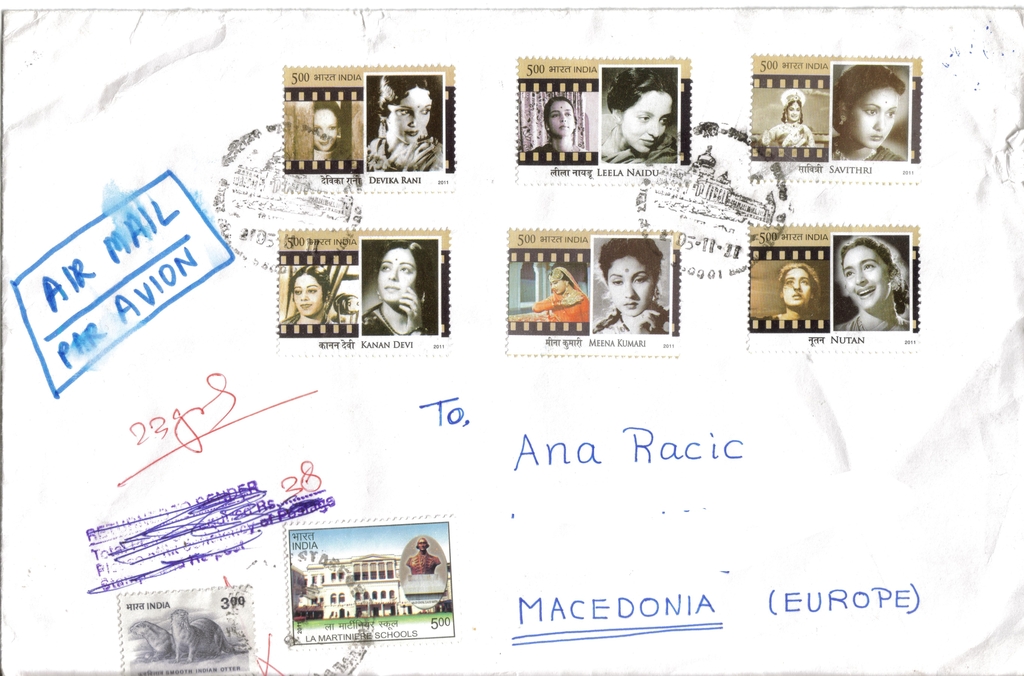
For today's theme on women for Sunday Stamps, I decided to showcase these not so famous ones from India...and for this I chose this cover with a set of commemorative stamps showing legendary heroines of the Indian Cinema...I must admit that the number of Indian/Hindi films is really scarce and this part of the world cinema has been somewhat neglected from my side - I should really do something to change this (and I am not talking here about those Indian soap-operas they used to show here on TV, I am talking about about real great movies here).
First we have Devika Rani, born in 1908 - an actress in Indian films who was active during the 1930s and 1940s. She was widely acknowledged as the first lady of Indian cinema and had a successful film career that spanned 10 years whose persona and roles in films were often considered socially unconventional. Her awards include the Padmashri (1958), Dadasaheb Phalke Award (1970) and the Soviet Land Nehru Award (1990). She died in 1994.
The middle stamp shows Leela Naidu - born in 1940, died in 2009 (and she had died on my birthday! =/)
She starred in a small number of Hindi and English films, including Yeh Raaste Hain Pyaar Ke (1963), based on the real-life Nanavati case, and The Householder, Merchant Ivory Productions' first film. She was Femina Miss India in 1954, and was featured in the Vogue along with Maharani Gayatri Devi in the list of 'World's Ten Most Beautiful Women', a list she was continuously listed from the 1950s to the 1960s in prominent fashion magazines worldwide. She is remembered for her stunning classical beauty and subtle acting style.
The third stamp in the first row shows Kommareddy Savitri (1934 - 1981) - she was an Indian film actress, director and producer. She appeared in Telugu as well as Tamil, Kannada and Hindi language films. In 1960, she received the Rashtrapati Award for her performance in the Telugu film Chivaraku Migiledi.
The bottom row starts with Kanan Devi (1916 - 1992) - an Indian actress and singer. She was among the early singing stars of Indian cinema, and is credited popularly as the first star of Bengali cinema. Her singing style, usually in rapid tempo, was used instrumentally in some of the biggest hits of New Theatres, Kolkata.
The middle stamp shows Meena Kumari (1932 - 1972 - oh, now she had died young....but there seems to be a reason for that) - she was an Indian film actress and poet. She is regarded as one of the most prominent actresses to have appeared on the screens of Hindi Cinema.
During a career spanning 30 years from her childhood to her death, she starred in more than ninety films, many of which have achieved classic and cult status today. She is regarded as one of the geatest Hindi movie actresses of all time.
Kumari gained a reputation for playing grief-stricken and tragic roles, and her performances have been praised and reminisced throughout the years. Like one of her best-known roles, Chhoti Bahu, in Sahib Bibi Aur Ghulam (1962), Kumari became addicted to alcohol. Her life and prosperous career were marred by heavy drinking, troubled relationships, an ensuing deteriorating health, and her death from liver cirrhosis in 1972. Kumari is often cited by media and literary sources as "The Tragedy Queen", both for her frequent portrayal of sorrowful and dramatic roles in her films and her real-life story.
The last stamp shows Nutan Behl (1936 - 1991) - an Indian actress who had appeared n more than 70 Hindi films in a career spanning over four decades. Regarded as one of the finest female actors in the history of Hindi cinema, Nutan was noted for playing unconventional parts, and her performances often received praise and accolades.
She holds the record of five wins of the Best Actress Award at Filmfare, which was held only by her for over 30 years until it was matched by her niece Kajol in 2011; on the overall she is the most-awarded actress in the female acting categories at Filmfare, with six awards alongside Jaya Bachchan. In 1974, she was awarded the Padma Shri by the Government of India.
n.B: Filmfare is one of the oldest film events in India an is presented annually by The Times Group to honour both artistic and technical excellence of professionals in the Hindi language film industry of India.
this set was issued on 13 February 2011.
Thanks a bunch to dear Sauj for sending it to me!
For more women beauties and accomplishments check today's edition of Sunday Stamps.
First we have Devika Rani, born in 1908 - an actress in Indian films who was active during the 1930s and 1940s. She was widely acknowledged as the first lady of Indian cinema and had a successful film career that spanned 10 years whose persona and roles in films were often considered socially unconventional. Her awards include the Padmashri (1958), Dadasaheb Phalke Award (1970) and the Soviet Land Nehru Award (1990). She died in 1994.
The middle stamp shows Leela Naidu - born in 1940, died in 2009 (and she had died on my birthday! =/)
She starred in a small number of Hindi and English films, including Yeh Raaste Hain Pyaar Ke (1963), based on the real-life Nanavati case, and The Householder, Merchant Ivory Productions' first film. She was Femina Miss India in 1954, and was featured in the Vogue along with Maharani Gayatri Devi in the list of 'World's Ten Most Beautiful Women', a list she was continuously listed from the 1950s to the 1960s in prominent fashion magazines worldwide. She is remembered for her stunning classical beauty and subtle acting style.
The third stamp in the first row shows Kommareddy Savitri (1934 - 1981) - she was an Indian film actress, director and producer. She appeared in Telugu as well as Tamil, Kannada and Hindi language films. In 1960, she received the Rashtrapati Award for her performance in the Telugu film Chivaraku Migiledi.
The bottom row starts with Kanan Devi (1916 - 1992) - an Indian actress and singer. She was among the early singing stars of Indian cinema, and is credited popularly as the first star of Bengali cinema. Her singing style, usually in rapid tempo, was used instrumentally in some of the biggest hits of New Theatres, Kolkata.
The middle stamp shows Meena Kumari (1932 - 1972 - oh, now she had died young....but there seems to be a reason for that) - she was an Indian film actress and poet. She is regarded as one of the most prominent actresses to have appeared on the screens of Hindi Cinema.
During a career spanning 30 years from her childhood to her death, she starred in more than ninety films, many of which have achieved classic and cult status today. She is regarded as one of the geatest Hindi movie actresses of all time.
Kumari gained a reputation for playing grief-stricken and tragic roles, and her performances have been praised and reminisced throughout the years. Like one of her best-known roles, Chhoti Bahu, in Sahib Bibi Aur Ghulam (1962), Kumari became addicted to alcohol. Her life and prosperous career were marred by heavy drinking, troubled relationships, an ensuing deteriorating health, and her death from liver cirrhosis in 1972. Kumari is often cited by media and literary sources as "The Tragedy Queen", both for her frequent portrayal of sorrowful and dramatic roles in her films and her real-life story.
The last stamp shows Nutan Behl (1936 - 1991) - an Indian actress who had appeared n more than 70 Hindi films in a career spanning over four decades. Regarded as one of the finest female actors in the history of Hindi cinema, Nutan was noted for playing unconventional parts, and her performances often received praise and accolades.
She holds the record of five wins of the Best Actress Award at Filmfare, which was held only by her for over 30 years until it was matched by her niece Kajol in 2011; on the overall she is the most-awarded actress in the female acting categories at Filmfare, with six awards alongside Jaya Bachchan. In 1974, she was awarded the Padma Shri by the Government of India.
n.B: Filmfare is one of the oldest film events in India an is presented annually by The Times Group to honour both artistic and technical excellence of professionals in the Hindi language film industry of India.
this set was issued on 13 February 2011.
Thanks a bunch to dear Sauj for sending it to me!
For more women beauties and accomplishments check today's edition of Sunday Stamps.
Monday, November 21, 2011
Czech Film Posters, Czech Republic
Some days ago I received this great cover from Radim.
Even though in the end I was prevented from participating in the 11.11.11 group, Radim had still decided to surprise me and sent me this great cover....with such a neat cancellation coz not only he sent the covers on 11th November but also sent them after 11 am, meaning the cancellations obtained another 11 in the postmark! Awesome, no??
and apart from the great cancellation, Radim used a great set of stamps, issued just this October, portraying Czech Film Posters.
The left stamp shows the poster for the film Markéta Lazarová (1966, Czechoslovakia) directed by František Vláčil.
The poster was designed by Zdeněk Ziegler, born on October 27th, 1932 in Prague. He is the author of three hundred film, exhibition and theatre posters, and had designed a number of sleeves for gramophone records and logos and also the author of a number of postage stamps and member of the Czech Post's Stamp Graphic Design Board
The movie is a 1967 Czechoslovak historical film and is an adaptation of a novel of the same name by Vladislav Vančura. The movie takes place in the Middle Ages, and tells the story of a daughter of a feudal lord who is kidnapped by neighbouring robber knights and becomes a mistress of one of them. Marketa Lazarová was voted the all-time best Czech movie in a prestigious 1998 poll of Czech film critics and publicists.
The other stamp portrays the film "Une femme douce" (1970, France) directed by Robert Bresson, while the author of the poster is Olga Poláčková-Vyleťalová, born on August 8th, 1944 in Hradec Králové and an author of overall seventy-six film posters which have won a number of prestigious international awards. The one portrayed on the stamp won the Cannes International Film Festival 1973 - Grand Prix for the Best Poster.
The movie is a 1969 French drama film and is Bresson's first film in color, and was adapted from Fyodor Dostoevsky's short story "A Gentle Creature (Кроткая)".
technical details:
Date of issue 5. 10. 2011
Face value 10 CZK
Size 40 x 50 mm
Printing method multicoloured offset
thanks a lot again Radim!
Even though in the end I was prevented from participating in the 11.11.11 group, Radim had still decided to surprise me and sent me this great cover....with such a neat cancellation coz not only he sent the covers on 11th November but also sent them after 11 am, meaning the cancellations obtained another 11 in the postmark! Awesome, no??
and apart from the great cancellation, Radim used a great set of stamps, issued just this October, portraying Czech Film Posters.
The left stamp shows the poster for the film Markéta Lazarová (1966, Czechoslovakia) directed by František Vláčil.
The poster was designed by Zdeněk Ziegler, born on October 27th, 1932 in Prague. He is the author of three hundred film, exhibition and theatre posters, and had designed a number of sleeves for gramophone records and logos and also the author of a number of postage stamps and member of the Czech Post's Stamp Graphic Design Board
The movie is a 1967 Czechoslovak historical film and is an adaptation of a novel of the same name by Vladislav Vančura. The movie takes place in the Middle Ages, and tells the story of a daughter of a feudal lord who is kidnapped by neighbouring robber knights and becomes a mistress of one of them. Marketa Lazarová was voted the all-time best Czech movie in a prestigious 1998 poll of Czech film critics and publicists.
The other stamp portrays the film "Une femme douce" (1970, France) directed by Robert Bresson, while the author of the poster is Olga Poláčková-Vyleťalová, born on August 8th, 1944 in Hradec Králové and an author of overall seventy-six film posters which have won a number of prestigious international awards. The one portrayed on the stamp won the Cannes International Film Festival 1973 - Grand Prix for the Best Poster.
The movie is a 1969 French drama film and is Bresson's first film in color, and was adapted from Fyodor Dostoevsky's short story "A Gentle Creature (Кроткая)".
technical details:
Date of issue 5. 10. 2011
Face value 10 CZK
Size 40 x 50 mm
Printing method multicoloured offset
thanks a lot again Radim!
Subscribe to:
Posts (Atom)