Showing posts with label 2009. Show all posts

Sunday, February 24, 2019

Astronomy, Malta

As I had promised (to myself), I am back to Sunday Stamps as the new A-Z cycle begins. Will start the new season with one of my favourite themes - Astronomy.


The year of 2009 was dedicated to this topic with the EUROPA stamps, where MaltaPost Philatelic Bureau issued its two stamps on 9th May 2009, featured on this FDC.
The Euro 0.37 stamp features a portrait of Galileo Galilei (1564 – 1642) by Francesco Boschi and one of Galileo’s sketches of the moon set against a starry background including the constellation Orion. The stamp also commemorates the 40 year anniversary of the first manned lunar landing by featuring the Apollo 11 lunar module “Eagle”.
The Euro 1.19 stamp shows the great telescope of William Lassell, set up in Malta between 1861 and 1865, against a background of stars showing Nebula M42, which Lassell himself observed on various occasions from Malta."

So you all new and old Sunday Stampers, check out the rest of the A-words today, and don't forget to contribute with yours :)

Sunday, September 30, 2018

Astronomy, Hungary

Well, the weekend getaway plans had failed, so I could do my Sunday duty properly for a change :)
And coming with a double G today, with Mr. Galielo Galilei (though maybe I could sneak in Galaxy here as well...)


On 8th of May 2009, Hungary issued this fantastic mini-sheet for that year's EUROPA theme, Astronomy. I am not into EUROPA stamps, but Astronomy is definitely one of my favourite subjects, so that is one joyous year to think about :D

As for the man himself presented on the stamps here, I don't think any special introduction is needed.

For more G-related posts, check out today's edition of Sunday Stamps

Sunday, September 2, 2018

Coral Reefs, USA

Well we are already into our third week of the new A-Z round, and it is time for some C's today


And my C today is dedicated to these Coral Reefs issued by the USPS on 26th August 1980.
Four different beautiful Coral Reefs are featured, starting with the Grooved Brain Coral, or the Diploria labyrinthiformi, that can be found in the western Atlantic Ocean and Caribbean Se. It has a very interesting maze-like appearance.
Next is the Elkhorn Coral, or the Acropora palmata, a prominent Caribbean reef-building coral, whose structure resembles that of elk antler.
The bottom stamps show the Chalice Coral (Echinophyllia aspera), it is a species of large polyp stony corals. It is a colonial coral which is partly encrusting and partly forms laminate plates or tiers. It is native to the western and central Indo-Pacific.
The last stamp is dedicated to the Finger Coral, or Porites compressa, which can be found growing on coral reefs and in shallow lagoons in tropical parts of the Indian and Pacific Oceans.  

It may not be seen very clearly on the scan, but this cover with Coral Reefs stamps also comes in with a very appropriate cancellation from the Coral Gables Branch in Florida. (all thanks to Bryon and his cool postal experiments :)))

For more cool posts for the letter C, hop over to the Sunday Stamps' blog

ps. there is also the very cute dolphin stamp which nicely contributes to the marine life theme on the cover :))

Thursday, June 14, 2018

Sudan

Just a single item in the mailbox today, but the one of the kind which you feel like immediately sharing. Plus I did say I would try to post more frequently and not only on Sundays, so I am seriously working towards achieving that goal on the long run :)


I first opted for a postcard, but turned out postcards were not an easy find in Sudan (not surprised), so I did agree on a cover, cos after all, it is Sudan, not a country where you have the chance to get mail from every day. So while Sudan may still be missing in my postcards' collection, it certainly ain't missing in my stamps' blog, so me is happy :D

I am especially glad since on of the stamps featured is China-related, issued in 2009 in a set of 3 stamps, to commemorate the 50th Anniversary of Diplomatic Relations with China. At first I thought it was a joint issue, but then I couldn't find such stamps being issued in the Chinese side.

The other stamp is also from a set of 3, issue in 2010, celebrating the National Unity (the Potency in Solidarity)

Quite a funny thing. I just learned that Sudan is also known as North Sudan since South Sudan's independence. Ha!

Those familiar with the latest political issues here, will know why the mention......


Sunday, May 6, 2018

The 100th Anniversary of the Inauguration of Constanta Harbour, Romania

If I wasn't as lazy as I am right now, I probably would have been more inventive with the L letter, but unfortunately I am, so I would just go with the first thing that crossed my mind, which, oh so surprisingly are lighthouses ;-D  Well, it is just one but it is still a lighthouse


On 23 December, the Romanian post issued this lovely set of two stamps, commemorating the 100th Anniversary of the Inauguration of Constanta Harbour.
The first stamp shows the sailing ship Mircea, while the second one, the Constanta Regele Carol (King Carol) I lighthouse.


The Constanța Harbour is located in Constanța, Romania, on the western coast of the Black Sea, and is the largest Port on the Black Sea and the 17 th largest in Europe. The favourable geographical position and its importance are emphasized by the connection with two Pan-European transport corridors: Corridor VII – Danube (inland waterway) and Corridor IV (railway).


The lighthouse featured on this stamp was dedicated to honor King Carol I, who died in 1914. It is known locally simply as the farul vechi (the old lighthouse) and it has been inactive since 1961.

well, that was quite short :)

For some more interesting L-posts, well you know the drill, click on the following link - Sunday Stamps

Sunday, March 25, 2018

Formula 1 Legends, Austria

Believe it or not, this post was started for the previous F episode, but I guess I somewhat overestimated myself and didn't finish it in the end, so it has been hanging around half-written in the Drafts section ever since.

So here we are at attempt number 2. Hopefully we won't have to wait for attempt number 3 to have it actually finished :)

And being that this weekend the new F1 season started, I guess this post is kinda on-spot as well now (It wouldn't have been for the previous F) (and not a bad start at all, with Kimi finishing third).

Just have to share with you this video from yesterday's Press Conference... no one else comes close to such reactions and facial expressions like Kimi ;-))))


And back to the stamps now.
I have a few issues from the Austrian Post (issued in different years), commemorating some of the greatest legends that the F1 world has seen (though I must say I am disappointed there is no Kimi here, but I guess you become a legend once you retire from the sport - though the Hamilton stamp from 2009 proves my theory wrong but oh well...)

first is this huuuge mini-sheet (as absurd as that may sound), issued on 07th June 2006, commemorating 8 great F1 drivers.

Talking in-depth about each and every one of them would be way too much (taking into account there are like 12 more people following below), so just the basics

In the sheet above, you can see:

- Jim Clarke - had won 25 Grand Prix victories, and was F1 Championship twice, in 1963 and 1965.
He was killed in a Formula Two motor racing accident in Hockenheim, Germany in 1968. At the time of his death, he had won more Grand Prix races (25) and achieved more Grand Prix pole positions (33) than any other driver.

- Sir Stirling Craufurd Moss - has been described as "the greatest driver never to win the World Championship". In a seven-year span between 1955 and 1961 Moss finished as championship runner-up four times and third the other three.

- Alain Prost - A four-time Formula One Drivers' Champion. From 1987 until 2001 Prost held the record for most Grand Prix victories and is considered as one of the greatest F1 drivers ever. Schumacher surpassed Prost's total of 51 victories at the 2001 Belgian Grand Prix. In 1999, Prost received the World Sports Awards of the Century in the motor sport category.

- Bruce McLaren - a New Zealand race-car designer, driver, engineer and inventor, whose name lives on in the McLaren team which has been one of the most successful in Formula One championship history. No championships won. He died in an accident during a test-drive on June 2, 1970.

- Jacky Ickx - a Belgian former racing driver who won the 24 Hours of Le Mans six times, achieved eight wins and 25 podium finishes in Formula One, won the Can-Am Championship in 1979 and is a former winner of the Dakar Rally

- Mario Andretti - an Italian-born American former racing driver, one of the most successful Americans in the history of the sport. He is one of only two drivers to have won races in Formula One, IndyCar, World Sportscar Championship and NASCAR (the other being Dan Gurney).

- Jackie Stewart - a British former Formula One racing driver from Scotland. Nicknamed the "Flying Scot", who competed in Formula One between 1965 and 1973, winning three World Drivers' Championships, and twice finishing as runner-up over those nine seasons. (This got me thinking now, cos I have a postcard with a train which says "Flying Scot" - I wonder if it had anything to do with him actually)

- Jack Brabham - was an Australian racing driver who was Formula One World Champion in 1959, 1960, and 1966. He was a founder of the Brabham racing team and race car constructor that bore his name. In the 1966 Formula One season Brabham became the first – and still the only – man to win the Formula One world championship driving one of his own cars.


Next I have this FDC issued on 29 May 2007, featuring again 8 more drivers.

- Phil Hill - was an American automobile racer and the only American-born driver to win the Formula One World Drivers' Championship. He also scored three wins at each of the 24 Hours of Le Mans and 12 Hours of Sebring sports car races.

- Gerhard Berger - an Austrian former Formula One racing driver. He competed in Formula One for 14 seasons, twice finishing 3rd overall in the championship (1988 and 1994), both times driving for Ferrari. He won ten Grands Prix, achieved 48 podiums, 12 poles and 21 fastest laps. With 210 starts he is amongst the most experienced Formula One drivers of all time.

- John Surtees - was an English Grand Prix motorcycle road racer and Formula One driver. He was a four-time 500cc motorcycle World Champion – winning that title in 1956, 1958, 1959 and 1960 – the Formula One World Champion in 1964, and remains the only person to have won World Championships on both two and four wheels.

- Graham Hill - was a British racing driver and team owner from England, who was twice Formula One World Champion. He is the only driver ever to win the Triple Crown of Motorsport—the 24 Hours of Le Mans, Indianapolis 500 and the Monaco Grand Prix.

- Gianclaudio Giuseppe Regazzoni - was a Swiss racing driver. He competed in Formula One races from 1970 to 1980, winning five Grands Prix. His first win was the Italian Grand Prix at Monza in his debut season, driving for Ferrari

- Juan Manuel Fangio - was an Argentine racing car driver. He dominated the first decade of Formula One racing, winning the World Drivers' Championship five times.

- Mika Häkkinen (or the Flying Finn - but there seems to be no train card named after him) - a Finnish former professional racing driver. He was the 1998 and 1999 Formula One World Champion, driving for McLaren and has been ranked among the greatest Formula One drivers in various motorsport polls.
Mika came for a visit in Skopje like over a decade ago, while he was still in the F1 business. It was one of those funny parades when a crowd of people gathers, waiting for their idol to come out and wave at them and then they all fall into trance. Cannot recall why I didn't attend this one, but if nowadays lets say Kimi came for a visit, you bet I would be there in the first row :D

- Emerson Fittipaldi , the last one in this set - a semi-retired Brazilian automobile racing driver who won both the Formula One World Championship and the Indianapolis 500 twice each and the CART championship once


And at last - another minisheet, this one issued on 27 May, 2009. "Only' four stamps here :)


- Wolfgang Alexander Albert Eduard Maximilian Reichsgraf Berghe von Trips - was a German racing driver who can probably take the medal for the longest name ever in the sport!

- James Hunt - was a British racing driver who won the Formula One World Championship in 1976. If you haven't seen Rush, then I recommend you do so, even if you are not an F1 fan. A beautifully done movie about the rivalry between James Hunt and Niki Lauda.

- Gilles Villeneuve - was a Canadian racing driver. Villeneuve spent six years in Grand Prix racing with Ferrari, winning six races and widespread acclaim for his performances. His son, Jacques Villeneuve, became Formula One world champion in 1997 and, to date, the only Canadian to win the Formula One World Championship.

- Bernie Ecclestone - the guy whose face used to pop out in every single F1 Broadcast - the former chief executive of the Formula One Group, which manages Formula One and controls the commercial rights to the sport.


So no wonder this couldn't be done in one go But at least attention has been given to those who deserve it, or at least to those I have on these Austrian stamps.

If you wanna take a break from all these people, check out the other entries for today's Sunday Stamps.

Sunday, May 29, 2016

Lighthouses, Ukraine

Wohoo! Today's Sunday Stamps edition is related to one of my all-time favourite subjects and that is lighthouses!! I'm in love with lighthouses! There is something so special about them, something so mystical and magical. And they hide so many stories at the rough seas...
So I can say that I surely have a lot of lighthouse-related stamps which kinda made it a bit difficult to make my choice today, but I think you won't be disappointed with these two amazing sheets of stamps coming from Ukraine.


The first one was issued in 2009 and contains 6 different Ukrainian lighthouses, from left to right you can see:
- the Kyz-Aulskyi lighthouse - located on the point of the Cape, South-East of Yakovenkove and helps guide ship(s) to the entrance of the Kerch Strait. The Lighthouse is in the diamond shaped peninsula of Crimea and is one of the Black Sea Lighthouse(s) in Ukraine. It is 28 metres tall and has a white, red, or green colour scheme (depending on the direction) with a flash of every 6 seconds.

- the Luparevskiy Lighthouse - located on the East coast, the south side of Luparevo. This Lighthouse is the second range for vessels bound upstream (North) in the estuary. The Lighthouse is in the Mykolaiv Area of Ukraine. It is 10 metres tall and has a white red colour scheme of continuous flash.

- the Yaltinskiy Lighthouse - located at the end of the Yalta breakwater, which extends South-Westward parallel to the shoreline. The Lighthouse is one of the best-known Lighthouse(s) in Crimea. The Lighthouse is in the diamond shaped peninsula of Crimea and is one of the Yalta Lighthouse(s) in Ukraine. It is 12 metres tall and has a red light colour scheme of 3 seconds on/4.5 seconds off.

- the Vorontsov Lighthouse is a famous red-and-white, 27.2 metre landmark (with a scheme of 3 flashes every 12 seconds) in the Black Sea port of Odessa, Ukraine. It is named after Prince Mikhail Semyonovich Vorontsov, one of the governors-general of the Odessa region. The Lighthouse is accessible only by boat.

- the Sarych Lighthouse - located at the Southernmost point of the Crimean peninsula as well as Ukraine and South-East of Sevastopol. It is 15 metres tall and has a white light colour scheme of 3 seconds on/3 seconds off.

- the Berdyansk Nizhniy Lighthouse - located at the end of a long, hook-shaped spit South of Berdyansk. The Ukrainian coast features four long sand spits projecting to the South. The Lighthouse is in the area of Sea of Azov, connected to the rest of the Black Sea by a very narrow Kerch Strait. The Lighthouse is accessible by boat. It is 22 metres tall and has a white colour scheme of 4.5 seconds on/3 seconds off.

Each of the stamps from this issue has a face value of 1.50 UAH.


The second sheet was issued in 2010 and again consists of 6 stamps (with a slight face value difference - there are 3 stamps of 1.50 UAH and 3 stamps of 2 UAH). And another difference is that I couldn't find nearly as much information as for the previous one.
Anyways, the lighthouses featured are as follows:

- the Sanzhyisky lighthouse - located North-East of the mouth of the Dnister and South-West of Odessa. The Sanzhiiskyi is one of the South Coast Lighthouse in Ukraine. Its height is 19 metres with a green colour scheme of two flashes every 15 seconds.

- the Tendrivskiy lighthouse

- the Tarkhankut lighthouse - located in Crimea at the Tarkhankut Cape 5 km southwest of the resort village of Olenivka. Its height is about 40 metres. The construction of the Tarkhankut lighthouse and its twin tower on the Khersones peninsula started in 1816 to ensure safe sailing in the area.

- the Pavlovskiy Front lighthouse, located in Crimea, station established 1863. Active; focal plane 65 m; continuous red light. 17 m octagonal stone tower, painted white with a red vertical stripe on the range line. This light replaced the original lighthouse, which had a focal plane of 22 m. Located about 500 m from the waterfront in Arsyncevo, about 6 km south of Kerch city.

- the Illichivskyi lighthouse -located in a small town called formerly Illichivsk, nowadays Chornomorsk, located south of Odessa on the Black Sea.

- the Khersoneskyi lighthouse - station established 1816. Active; focal plane 34 m; white light, 3 s on, 3 s off, 3 s on, 3 s off, 3 s on, 6 s off, 3 s on, 3 s off, 6 s on, 3 s off, 6 s on, 18 s off. 36 m round stone tower with lantern and gallery, painted white. This historic lighthouse stands on the southwest corner of the Crimean peninsula. The original lighthouse was a conical stone tower. It was replaced in 1929 by a lighthouse built from the same plans as the Tarkhankut Light. Almost completely destroyed during World War II, it was replaced by a wood tripod tower until a copy of the 1929 lighthouse could be built. The tower is greatly endangered by rising sea level, and a stone berm and semicircular sea wall have been built to protect it. The unusual flash pattern, the Morse code "SW" for Sevastopol', is a traditional welcome-home for Russian sailors. Located at the tip of the peninsula about 15 km west of Sevastopol'.

So that would be my contribution for today. Can hardly wait (and be jealous of!) other people's collections of lighthouse stamps :) You can see them at today's Sunday Stamps episode.

Wednesday, March 9, 2016

75 Years since the Birth of Gagarin, Macedonia

If it wasn't for his tragic death, today Gagarin would have been celebrating his 82nd birthday...but unfortunately he only managed to get to his 34th one.....


This FDC was issued on 2 February 2009 by the Macedonian Post Office, commemorating the 75th Anniversary of Gagarin's birth....with a face value of the stamp of 50 MKD - one of the numerous stamps with simply useless values, since they are just too high to be used on either a postcard or regular letter up to 20 grams. And that is such a pity cos I am sure that many people would love to see this stamp on the mail I send, but unfortunately the Macedonian postal authorities didn't really care about it.

Anyways, just wanted to commemorate this day, won't go into Gagarin stories...you all know about him and his achievements and importance :)
It just kinda surprised me that there was no google-doodle about Gagarin today....


Sunday, August 3, 2014

European Capitals on Stamps!

Good morning all! It is a nice Sunday morning and it is time for Sunday Stamps!
I feel like Im gonna have a lazy day in general, and spend it mainly on cards, stamps and blogging on the same topics...yeah, I've been allowing myself a lot of lazy days lately, but come on, it's summer, so why not :P

Theme of today...faraway (exotic, romantic) places....hmmm, at first I thought this should only be about some places far far away, and I had the association of  'rare' countries in my head as well, don't know why....but then I saw Viridian's post, and I realized I could probably show these beauties, and I've been wanting to for a long while. After all, a faraway place is a rather relative thing, depending where on Earth you actually are...and same goes for romantic/exotic...it is an individual perception (and you'll see a clear example of this somewhere below).

So ladies and gentleman, fasten your seat-belts, and get ready for a short European tour through these awesome sheets of stamps issued by the French postal service! Each year, they portray a European capital. So far they've covered around ten I think...I do not have all the issues yet, but I hope to acquire them over time :)

And first comes Budapest, Hungary's capital, issued in 2011!


Beautiful city, that I had the chance to visit back in 2001, but I'd like to visit it again one day since I don't think I was able to absorb enough of it back then, neither enjoy the small cosy moments of just sitting at a cafe and doing nothing but relaxing and observing people.
On the sheet you can see the Parliament (which I believe is like on almost every Budapest postcard), the Great Synagogue, the famous Chain Bridge (one of the many bridges over the Danube), the Royal Palace (which I actually do not remember seeing), the Széchenyi thermal bath (haven't seen it either), the Matthias Church, the Heroes' Square, and that round thing in the middle that at first glance looked like a coin to me, actually represents St. Stephen's Basilica (or as it is in French, Basilique Saint-Étienne).


In 2010, it was Paris. And here comes the clash of romantic vs non-romantic for me. Yeah, I know Paris is considered as one of the most romantic and beautiful cities and all...but how do I put this...Paris has been one of the greatest disappointments in my life, and to me it is just way too overrated! Sorry guys, nothing personal and no offence, but Paris doesn't give me thrills no chills...and that's why at the beginning I said that 'a romantic place' is also a rather relative and subjective thing :)


However, out of all the stamps issued for the European Capital series, I do believe the one portraying Paris is the most beautiful one. Well, ok, it is issued by the French postal service after all, maybe they were biased :P
My favourite part of the sheet is the cafe atmosphere shown at the very left, plus I love the detail of part of the building being shown.
Other than that, you have the Triumphal Arc (we have one here as well I must say), Notre-Damme, the Eiffel Tower (how does it feel to climb on the Eiffel and all you see below is fog fog fog? terrible! =/), the Basilica of the Sacré Cœur, Palais Garnier (a famous Opera House in Paris), a Champs-Élysées street plate...and at the very top, something that is called "Under the roofs of Paris".

If out of nowhere someone French stops talking to me/unfriends me or so, I'll blame it on this post :)


The latest issue from the series (issued this year, that is) is the beautiful beautiful Vienna! ❤


Visited it the same year as Paris, but was left with two very different impressions (so I dont know, maybe someone could tell me here something about my personality, something I am unconscious of, based on the places I like and dislike :))

Vienna is portrayed with the Secession Building (or also known as the Secession Pavilion), the Belvedere Palace, the Karlskirche, and the Hofburg Palace.
What I can't possibly understand here is how come they excluded the Schönbrunn Palace...

Well, Vienna is a place I fell in love with at first sight...a place where I felt at home, due to its lovely atmosphere and the overall high percentage of Serbian/Croatian languages I could hear spoken in the streets...for someone having grown up in Yugoslavia, yeah, that makes you feel like home...and it was simply my all time favourite place that I've been to...that is, until I visited Prague last year...


and yes, here comes Prague, issued in 2008! ❤❤❤

Another city that is probably spoken about and praised too much..but here, things clicked from the starters...I'll never forget the early morning when the bus arrived to Prague...and I just looked outside the window...and was in love! It is one of those places that captivated me IMMEDIATELY! I didn't even have to walk around...the very first view from the bus was just enough...spending a few days there just cemented our relationship...and it was then when Prague took over the pedestal from Vienna and has been there ever since...I wonder if there will be a place that will dethrone Prague..and I really wonder which place that's gonna be :)


Starting with the Charles's Bridge..then the Powder Tower, St. Nicholas's church in the Lesser Town, the famous Astronomical Clock, which is beautiful, but to me the performance is just plain boring and not worth the fuss (same goes with the one in Münich)...then you can see here the Church of Our Lady before Týn, the Castle, the nice and charming Golden Street....and a candelabra at the Hradčany, or the Castle District.
Ahhh, Prague......


Next comes the capital featured on the 2013 stamps...and another place due to which people may mysteriously stop talking to me...Madrid.


Well ok, I like it more than Paris..but however, this is another place I have not been impressed with...and couldn't find that bond...the city is nice and all and there are some great places to see, but personally just wasn't my type...I don't know if the fact we didn't bond was also due to the fact that during the time I was there, there were protests and I didn't really feel at ease...but however, I left Madrid rather disappointed...probably the best thing about it were the churros! Oh boy, those churros....a heavenly delight! I tried churros in Mexico too, but they didn't even come close to the ones in Madrid. I didn't try churros anywhere else in Spain, and Madrid has the Chocolateria San Gines, recommended on all travelling websites about 'places to see and do in Madrid'..so I guess if I ever wanna go back to Madrid, it would be to indulge into those churros again...and oh yeah, go to Madird Atocha, since I didn't get to do that last time (that is the Railway Station in Madrid :))
A quick go-through the places shown: Plaza Mayor, the Almudena Cathedral, the Plaza de Cibeles and the Royal Palace...where we wasted two hours waiting in a row, on what was supposed to be a free entry in the afternoon, just to find out that the 'free' entry was not valid for countries outside the EU...or unless you are from a Latin-American country...yeah, just to add to the annoying Madrid experience :))
Btw, I believe those 'artistic' pictures come from the Prado Museum..


And last comes the only place out of these that I haven't had the chance to visit, but that I'd really love to one day...there is something just so inviting about Lisbon!


Since I cannot give my personal insight here, I'll just name the places shown (and I'm familiar with most of them thanks to the postcards I have :))

So you have the Jerónimos Monastery, the Santa Justa elevator, the National Tile Musuem, the Belém Tower, the Bairro Alto District, St. George's Castle and the Monument to the Discoveries (Padrão dos Descobrimentos).


Well, a bit of a longish post, though I tried not to get into details about each of the place shown on the stamps.

And I have to give a thank-you note here to Eric, thanks to whom I have these beauties in my collection!

If you wanna check out some more faraway/exotic/romantic places, click on the button below...and have a great Sunday!

Sunday, June 22, 2014

Dolphins and Sharks, India-Philippines

Time for Sunday Stamps...and my first ever post written from my backyard! On a sunny day!! Feels so lovely! My dad just installed this roof over our terrace, so now, rain or shine I can sit, eat, work, read...in my backyard, outside in the fresh air! Cannot explain how happy I am cos of this..even work feels more pleasurable now!

Anyways, without any further ado...the theme for today is 'anything you wish' and while checking some of the recent envelopes I have received, my eyes got set on this...a perfect kind of cover for me, so here it comes to see the light of day...


well I must say that I absolutely ADORE ADORE ADORE dolphins!! And my earliest memory of them is this Flipper TV Series. Yeah, I may not have been born when the show was created, but they did show it here years later when I was a kid...and loved it! I have seen dolphin shows, but my absolute dream is one day to swim with dolphins...even the very thought of it gives me this stomach anxiety..I cannot even imagine how i would actually feel once it happens..and I hope it DOES happen one day.
Speaking of sharks....my earliest memory is again from the childhood...with one of those horror shark-related movies...and NO, i would not want to swim with them, though I still do not approve people killing them...unless in actual danger

Anyways, regarding the cover...this is a joint issue between India and the Philippines, issued in 2009, where first of allyou can see the South Asian river dolphin (Platanista gangetica), which is a freshwater or river dolphin found in India, Bangladesh, Nepal and Pakistan.
Besides the dolphin, you can also see the whale shark (Rhincodon typus), which is a slow-moving filter feeding shark and the largest known extant fish species.It is usually found in tropical and warm oceans and lives in the open sea, with a lifespan of about 70 years.

Well, dangerous or not, I do love the cover...and as long as the sharks are on stamps, I feel on the safe side ;-)

For more interesting stamps, click on the button below...and enjoy your Sunday!


Sunday, September 29, 2013

Ecology - Balkan Mountain, Serbia/Bulgaria

It is time for another Sunday Stamps' entry...with the theme of birds this time...and here I come to show you these two awesome FDCs I got myself few months ago when I visited Belgrade...in a way, you can say I "robbed" the philately store during my visit :D

Anyways, I am happy to have this opportunity to present this joint issue between Serbia and Bulgaria...I really wonder why WE don't have such awesome joint issues...or why we BARELY have any joint issues in the first place?! The joint issues mean closer cooperation between the postal administrations and exchange o valuable experiences in the field of postal circulation. On this occasion, Serbia and Bulgaria have chosen to portray the Balkan Mountain (or Stara Planina as known in Serbia and Macedonia for example) which belongs to the big Balkan mountain range that runs 530km from the Black Sea, on the East, to the Vrška Čuka Peak on the West and is part of the Carpathian-Balkan Mountain range. The smaller, western part of the mountain is located on the territory of East Serbia. Its highest peak is Botev (2376m) in Bulgaria, while on the Serbian side, the highest peak is Midžor (2169m).
The area of the Balkan Mountain was declared a National Park back in 1997 and is also classified as an area of interstate (Green Belt Programme) and international (Important Birds Areas, Important Plants Areas, Prime Butterfly Areas) etc
The ornithofauna of the Balkan Mountain is very rich and until nowadays (speaking about 2009 here), has 206 recorded bird species, of which 104 are protected by the Bern Convention and the Regulation of the Serbian Government on Natural rarities protection)
The motif of these jointly issued stamps is the Balkan mountains landscape with birds: Scolopax rusticola (Eurasian Woodcock) and Monticola saxatilis (Rufous - tailed Rock-thrush)


The Eurasian Woodcock is 33-38 cm in length, including a 6-8cm long bill. Its eyes are located high on the sides of its head, giving it a 360° monocular vision. Eurasian woodcocks nest on the ground, in low cover in woodland. It feeds by probing in the ground for invertebrates with its long bill. This species has a global population of an estimated 15-16 million birds.

The Rufous - tailed Rock-thrush is a songbird which is regularly seen on the Balkan Mountain. It is a medium sized bird of 17-20 cm in length. This species breeds in open dry hilly areas, usually 1500m above the sea level. In Serbia, its population is estimated to be between 1400 and 2000 individuals, and according to this fact, is considered as a declining species in the country.

And here you have the s/s on the other FDC...it is just awesome, don't you think?


for more birdy stuff today, click on the link below...and have a great Sunday!!


Sunday, January 20, 2013

Stamp Day, France

well, after quite some time, here i am with a post for Viridian's Sunday Stamps.

the theme today is Cartoons and Cartoon-like drawings...well, here is a very nice cartoon cover - couldnt get any more cartoonesque I think :)

On 28 February and 1 March 2009, 116 cities in France (in 92 departments) hosted the 10th edition of the "Fête du Timbre" ("Stamp Fair").

and as it has been the case since 1999, the French Post has chosen for this Stamp Day some comic book and children's literature heroes as topic in order to attract more young people towards the collection of stamps.
So here you have the Looney Tunes characters, that im sure most of you are familiar with :)


Im happy to be an owner of this cover with the three stamps that were issued (€ 0.56 each), where you can see Bugs Bunny and Duffy Duck, then on the next stamp are Wile E. Coyotte and the Roadrunner, and on the final stamp you have Tweety and Sylvester.

above the stamp you can also see the souvenir sheet, consisting of one € 1.00 stamp, where apart from the above mentioned characters, you can also see Taz (the Tasmanian Devil), Marvin the Martian and Yosemite Sam.

I loved watching these cartoons when I was little (and not so little). And out of all these, Sylvester is probably my favourite...probably coz of being a cat...and his clumsiness...though Sylvester Jr. was even cuter :) And I just cant stay indifferent to that lisping-talk :)


thanks a lot to Eric for sending me this cover (from whom I also stole some of the information regarding the stamps :))

well, wishing you a good Sunday and great week ahead. For more cartoon-like stuff, click on the button below

Sunday, October 7, 2012

Macedonia in EU, Macedonia

Hello my dear readers and Sunday-stampers...hm, ok, maybe not the right use of the word, but to me it seemed as a nice sort of neologism...

the theme for this Sunday is public architecture, esp. bridges....so i stuck to that, instead actually interpreting the theme broadly...and i was about to go with those Russian bridges' stamps...but then i thought I could actually contribute with something different with which i have much less of a chance to overlap and have a double post with someone else, since I dont think that many today would go with something Macedonian...and Ill leave the Russian ones for some other time :)


well, I have two FDCs for today which I think fit in well into the theme, even though their initial subject is something totally different.
Each year, the Macedonian postal service issues stamps dedicated to the European Union...I dont know why it is called Macedonian in EU, when we still arent an EU member state (frankly I dont even want to be part of EU, but it is not like anyone is asking me or the public, those things are already settled behind the scenes about when and how are they going to happen).
Anyways, as I said, these stamps are issued each year, when some capital of the EU is presented on those stamps. In 2009, as you can see above, it was Prague (Czech Republic) that was chosen, and here you can see among else the very famous Charles' bridge in Prague, over the Vltava river.
Its construction started in 1357 under the auspices of King Charles IV, and finished in the beginning of the 15th century. As the only means of crossing the river Vltava until 1841, the Charles Bridge was the most important connection between Prague Castle and the city's Old Town and adjacent areas (you can also see those on the FDC).

Unfortunately I havent yet been to Prague, though Id really love to...and feel the bustling atmosphere of this place.


this second FDC was issued in 2011 and here you can see Budapest...well Budapest is famous for its numerous bridges over the Danube river but the Chain bridge is probably the most famous and widely known among the bridges of Budapest (and I must say that Ive actually been here and crossed this bridge! And Budapest is a beautiful place....though Id need to go there again coz that was like 10 years ago, so Im sure Id see Budapest with different eyes nowadays than back then).
The Chain bridge was the first permanent stone-bridge connecting Pest and Buda, and only the second permanent crossing on the whole length of the river Danube, opened in 1849. The portals are decorated with lionhead-shaped capstones and the coat of arms of Hungary with the crown and a wreath of leaves.
The bridge has the name of István Széchenyi attached to it actually, a major supporter of its construction, but is most commonly known as the Chain Bridge.
And on the stamp, you can also see the famous Hungarian Parliament building.

so, I hope you liked my pick for the day...to see what others have chosen, click on the button below...and have a great day :)

Sunday, February 5, 2012

Protection of the Polar Regions & Glaciers, Croatia

well, this Sunday's theme at Viridan's is 'anything you wish', so here I thought Id post something related to the weather outside...we've been having these polar temperatures and snow for days now...ok, not to the extent in order to earn the title 'polar region' but still :) It is beautiful outside indeed, when everything is so white, and the air feels clear....the only problem is the traffic chaos, but we'll live....as always :)


before we begin, i would like to make two questions:


1. What is it that YOU do to contribute to the protection of the environment?

2. According to you, what is a mini sheet and what is a souvenir sheet? For me, this above would be a mini sheet but the HP says it is a souvenir sheet, so I would like some input from your side

thanks! :)


I love the theme of Polar Regions and Glaciers' Protection and it is really a pity the Macedonian post office has not issued any. I mean, you don't have to be a country to be facing this problem...as far as I know, many of our neighbouring countries do pay attention to this and have issued such thematic stamps....and they are all so lovely!
I have had my eyes on this Croatian issue for a long while, and then one day it surprised me in my mailbox since dear Agi decided to send it to me for Lori's NCC RR!

What the HP had to say about the issue:
When polar areas and their endangered condition due to climatic changes are mentioned, most people immediately think of a sad picture of a polar bear that is compelled to swim over large distances in search for an iceberg somewhere in the North Pole region. Although being excellent swimmers, polar bears are unable to survive in those regions without ice. Disappearance of the ice cap during summer months and the threat to ice bear habitats have become the symbol of endangered condition of the ice-covered regions caused by recent climatic changes. The scientific community is unanimous in their confirmation of the existence of global warming, as well as of the responsibility of humans for recent changes, which has been confirmed also by the latest report of the United Nations’ committee on which several thousands of scientists worked. Of course, there are also natural exchanges of ice ages caused by the change of the Earth’s orbit or by the tipping of the Earth’s orbit, the so-called Milanković’s cycles. However, they do happen on time-scales of thousands of years and cannot be taken as an explanation for the recent accelerated increase of temperature. Although these changes are global, they do not affect equally all the regions. The most threatened ones are those in the polar circle. In summertime, almost all ice melts in the North, whereas the coastal regions in the distant South experience one of the highest temperature increases on the Earth i.e. 2.5 °C in one hundred years, on the top of Antarctic Peninsula. For instance, disintegration and melting of the ice shelf Larsen B 2002 on the Antarctic Shelf, an ice shelf with an area eight times the area of Croatia’s island of Krk, caused a surprise among the scientific community because no one could foresee such a rapid development in that direction. For all the above mentioned reasons, the period 2007/2008 was proclaimed the International Polar Year, on the occasion of which the scientists carried out a number of projects and measurements, with the specific purpose of better understanding and protecting the polar areas and glaciers. In the last 125 years of modern science, it has been the third time that the world joined its forces in the research of the polar areas, the last time in the distant year 1957/1958 on the occasion of the World Geophysical Year. The projects related to the Polar Year are due to be finished in March 2009 and therefore it is very convenient that the issue of a commemorative stamp on the protection of the polar areas coincides with the end of great effort in science to research and protect them better. An important issue has been left open: what we as individuals can do to protect the polar areas. Although we are very far away from them and our country is small, we can still make quite a difference. The atmosphere is getting warmer and warmer under the influence of glasshouse gases and it is not irrelevant where they arise from. The Western world generates enormous quantities of these gases and a fair part of them is superfluous and their emission can be reduced. As a nation we can plan the sustainable development which will not be an additional threat to the Earth and as individuals we can save and more efficiently use the energy; we can plan better and reduce our "imprint" in the emission of glasshouse gases, in order to help everyone on the planet to keep their habitats, even the polar bears. It is believed that this commemorative stamp will have a certain impact and contribute to raising of awareness on the necessity of protection of the polar regions and glaciers.

Technical details:

5kn of each stamp
Size: 112 x 73 (31,24 x 35,50) mm
Paper: white 102g, gummed
Perforation: Harrow, 14 Tehnique: Multicoloured Offsetprint + Embossed print and Varnish
Date of issue: 27.3.2009

for other random themes, pay a visit to Viridian's blog


have a great snowy or sunny Sunday everyone (depending on where you live) :)

 I Agi, još jednom, hvala i najviše!!! <3

Saturday, October 1, 2011

Heritage Railway Stations of India, India

I was a bit doubtful when preparing this update, regarding what to put and what to exclude, but in the end I decided that it would be the best if I just placed all I had regarding this issue....in case you have something additional belonging to it, feel free to contact me :)


and these are the first Indian stamps featured here as well....so Im glad to have the chance to present you this stuff.

As the title says, this issue presents the Heritage Railway Stations of India and consists of 4 stamps, as you can see above...the stations represented are as follows:
- top left corner shows Howrah Station (one of the four intercity train stations serving Howrah and Kolkata) - bottom left corner shows the Old Delhi Station ( the first railway station to be built in Delhi)
- top right corner shows the Chennai Central Station (the main railway terminus in the city of Chennai and home of the Southern Railway and the most important rail hub in South India)
- bottom right corner shows the Mumbai CST Station (is a UNESCO World Heritage Site and historic railway station in Mumbai which serves as the headquarters of the Central Railways. It is one of the busiest railway stations in India, and serves both as a terminal for long distance trains terminating in Mumbai as well as the Mumbai Suburban Railway)


I was happy to receive this Special Cover for this issue, commemorating the Frontier Mail from Bombay to Peshawar via Baroda.

The Bombay, Baroda and Central India Railway (BB&CI Rly) was a company incorporated in 1855 to undertake the task of constructing a railway line between Bombay and Baroda in India. Baroda (Vadodara) was a part of historic BBCl Railway. The first train came to Baroda on 9th January 1861 and the city was connected with Broach and Surat. In 1863 BB&CI Railway completed the Surat-Baroda-Ahmedabad line. Bombay (Grant Road) was connected with Baroda in 864 via Navsari and Bulsar. By 1879 Baroda was connected with Delhi via Palanpur, Ajmer, Jalpur and Alwar. On 5th November, 1951 the BB&CI Railway was merged with the Saurashtra, Rajputana and Jaipur railways to give rise to the Western Railway.

The frontier mail was flagged off on 1st September 1928, from Colaba Terminus, the main station on the BB&CI Railway. It was the first luxurious and prestigious train in the Indian Subcontinent. The radio facility was provided for the first time in a running train in India and it was also the first fastest train of India. After Independence, it is running between Mumbai and Amritsar. The train has now been renamed "Golden Temple Mail".


And Im honoured to have not one, but TWO fantastic FDC copies...since the stamp's arrangement is different, i can freely consider them as different and equally important for my collection!
One arrived as a lovely surprise from Laura, and the other one arrived from Som.


Indian Railways has stood as an emblem of progress spanning over 150 years. In this period, it catalyzed India's industrialization and has emerged as a lifeline of India's development. Some railway structures are monumental in nature representing significant developments in architecture and technology. On 15.08.1854 a train ran from Howrah to Panduah. This Heritage Run is commemorated by the release of a set of four stamps representing four Heritage Railway Stations in India.
A plan for railway in India was first put forward in 1832. In 1844, the Governor-General of India allowed private entrepreneurs to set up a rail system. The first train became operational on 22nd December 1851 in Roorkee. On 16th April 1853, the first passenger train ran between Bori Bunder, Bombay and Thane, covering 21 miles. The rail network then developed rapidly, radiating from Bombay, Madras, Calcutta and Delhi.
Railways in India were patrons of a style that combined the prestige and relevance of train travel with imaginative innovations of engineering. They were designed with grandeur and dedicated to the customer for eternity. Also, the four Metro Stations - Kolkata, Mumbai, Chennai and Delhi were monumental in scale, striking architectural creations of the 19th century, innovatively designed and incorporated local traditions and craftsmanship. They became a focal point of each city. With the coming of the Railways, there came up railway stations, Railway companies vied with each other to build imposing railway station buildings.
In 1853, India's first train should have started from Howrah but the ship bringing the coaches sank in the river Hoogly and the steam locomotive was mis-dispatched to Australia. It opened in 1854 as the first in the East and amongst the first few stations in India, as a temporary tin shed, for just two pairs of trains, a small booking office and one line along a narrow platform. The first train of the East Indian Railway, driven by Joshua Greenbo, ran from Howrah to Hoogly on 15th August 1854, a distance of 24 miles. This led to India's 1st commercial railway goods corridor from Howrah to Raniganj. The present day station became a necessity with increasing number of trains and opening of the Bengal Nagpur Railway from Howrah in 1900.
From humble beginning for just 5 carriages of only one train, Howrah Station now is among the largest railway stations in the world, catering to all major cities in India, handling over a million passengers a day through 23 platforms and over 300 pairs of trains. From within its magnificent archaic structure, huge crowds and the olden day charm of this great monument make this a wonderful destination. It became and still remains a gateway to the entire eastern and northeastern India.
The first imposing heritage station of the Railway's came up with the Victoria Terminus, housing the office of the Great Indian Peninsular Railway Company. This building was started in 1878 and it was completed and thrown open to the public on New Year's day 1888. The ceiling are very high and exude a sense of space and freedom. The magnificent monument was designed by F.W. Stevens. The decorative carved detail was executed by native carvers from models supplied by Mr.Gomez and the students of the Bombay School of Art. The buildings are faced with a light buff coloured Coorla stone with dressings, cornices and moldings in Porbandar and Seoni stones. The total cost of the whole building was about Rs.27 lakhs. All the work was entirely executed by indigenous labour. In quick succession came the large and imposing station buildings at Madras and Howrah. The landmark in Madras Central Station is the Victorian Clock Tower.The Howrah Station has a predominance of arches with a touch of contemporary British architecture and local trappings. Railways came to Delhi with the establishment of the imposing Old Delhi Railway Station constructed in 1867. The building has several Gothic features. The two-story building has deep verandas on both floors and though the original building is in a good condition, many modifications and additions have since been done. Semi-octagonal turrets rise from the corners of the building.

Date of issue: 16 August 2009
Denomination: 5.00 INR (each stamp)
Width             57.0 mm
Height             32.0 mm

Sunday, May 22, 2011

Handicrafts, Macedonia

I guess Im lucky that Viridian has chosen Sunday as a day for featuring stamps coz it seems to be the only day of the week when I can dedicate some time to it.
This week's theme are handicrafts....being that Macedonia is rich in these, and there are also a number of stamps issued featuring handicrafts, I decided to dedicate this post to my country again....and will save the other nations' handicraft stamps for some post in the future.

Ive chosen two sets of stamps for today....the first one is actually a definitive issued in 2007, representing a traditional woven bag from the 20th century from the Skopje region


this is one of the typical designs that can be seen on the Macedonian traditional clothes as well as tapestries, carpets, bed-covers, curtains and other household items used in the Macedonian rural and urban houses. Each Macedonian region has its unique designs but in general they are all rich in colours and ornamental details.
This kind of bag is something which people used to put bread loaves and cheese and maybe peppers inside when they went on the pasture fields and had to stay there all day...or by school children who had to travel many many kilometres in order to get to their school. These kind of bags have often been described in the traditional Macedonian legends and stories and to those familiar with them and the Macedonian people and culture in general, they bring an image of a freshly baked bread, perfectly hot, where the cheese is put inside between two slices and melts...a very simple but delicious meal for many.
Recently I went to the Night of the Museums event...well, sadly it only took place at one museum, but something is better than nothing. And the museum has this permanent exhibit of ethnological items among which these kind of bags are portrayed too....I have to say I loved that part, showing so many different traditional clothes and accessories, coming from different regions in Macedonia.

The stamps has a face value of 12 denars, comb perforation and comes in a sheet of 25 stamps. The offset printing technique has been used. And what I like about it is its size...it is rather small (28x25 mm) and fits very well on postcards among other additional stamps (coz this one is not enough for postage).

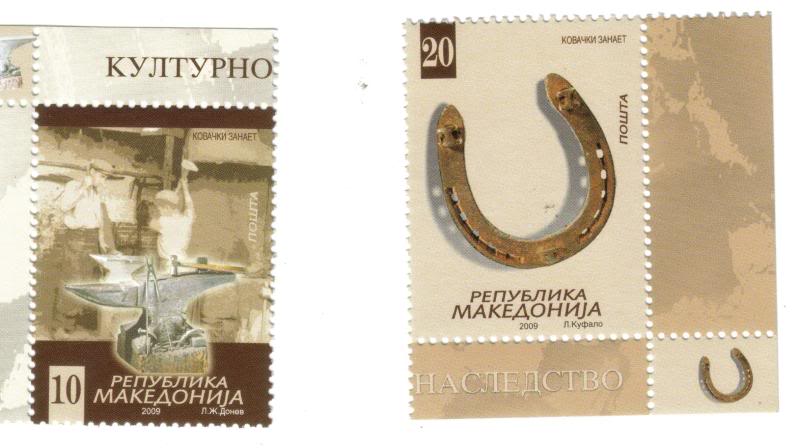
The other set of stamps I chose for today was issued in 2009 and consists of two stamps, under the Cultural Heritage subject:


the 10 denars stamp (the one on the left) depicts an anvil....it is something that is still used today by the craftsmen, blacksmiths in particular...even though as a walk of life it may be disappearing, if you walk around the Old Bazaar in Skopje, for example, you will come across old small blacksmiths' workshops. From what Ive heard, a craftsmen chamber has been established in Macedonia, which offers help and support to the craftsmen people.
Here is one video, which unfortunately is in Macedonian, but it is a nice example to see what I was talking about...the video has been taken in the Old Bazaar in the blacksmith street, where years ago it was full of blacksmith's workshops...nowadays, the remaining people who still perform these activities complain how the modern industry simply destroys the crafts and how they only work for little money and that young people nowadays are totally disinterested in these so-called, old-fashioned activities.

http://www.makdenes.org/video/4654.html

the second stamp of a 20 denars face-value represents a horse-shoe. I dont know if this belief is present in other cultures as well, but here in Macedonia it is believed that if one hangs a horse-shoe on the wall in the house, that should bring luck to that family or that they will protect you from the evil spirits and goblins :)
The open part of the horseshoe should look downwards according to its position in the horse....so as the horse runs forwards, so the fortune should go forwards inside the house.

the size of both of these stamps is 40.2x30.2mm, offset printing technique in a sheet of 9 stamps. When used together, both stamps are postage-perfect for postcards.  

well, sorry for the longish post...I hope you werent bored :) For more crafty posts please visit Viridian's blog...just click on the button below:

Sunday, August 22, 2010

125th Anniversary of the Railroad in Serbia

Seems like there are a lot of 125th railway anniversaries around the world :)


This lovely FDC comes from Serbia, in order to commemorate their 125th railroad anniversary.

The first railways on the territory of Serbia were already built in the middle of the XIX century in Banat which was part of the Habsburg Monarchy at the time. Although the construction of the railway in the Principality of Serbia was already considered, the conditions for it were created just after the Congress of Berlin, in 1878, when the Principality got its complete independence. During this Congress, decisions were made to establish routes which would connect Europe (through Serbia and Bulgaria) with Turkey and Middle East. In accordance with those decisions, on 15th September 1884, Serbia opened its first public railroad route from Belgrade to Niš so that day represents the birthday of the Serbian Railroad. The first train had a steam locomotive CS No.1. This was one of the most important events in the newer history of the country. The railroad route from Belgrade to Niš was the biggest and most expensive project accomplished during the XIX century in Serbia. With the later construction of the railroad system this route had a great influence on the modernization and lifestyle in Serbia, its connecting with European countries, economic development and position in the scope of international relations. Even nowadays, this route as a segment of Corridor X represents one of the most important railways in Serbia and South-East Europe. It is an electrified railroad with modern electric locomotives.
The railroad route Belgrade-Niš is 243,5 km long and is constructed as a narrow-gage railroad with 23 stations. The biggest and most beautiful station buildings were at the time erected in Belgrade and Niš. The building of the Belgrade station has undergone many wars but preserved its beautiful original architecture. The original building of the station in Niš was so damaged, during the Anglo-American bombing in 1944, that it couldnt be renovated. After the many years of use of a provisory building, a new one was solemnly opened in 1973 as one of the biggest and most beautiful in Serbia.

Motifs on the stamps:
- stamp face value 22,00 dinars: the first steam locomotive CS No.1 of the Railroad of Serbia and in the background the building of the station in Belgrade;
- stamp face value 46,00 dinars: electric locomotive series JŽ 441, in the background is the building of the station in Niš.

Date of Issue: 8 September 2009
Stamps' Width: 30.0 mm
Stamps' Height: 37.5 mm
Layout/Format: sheet of 25
Perforations: 13.25 by 13.25

Saturday, July 3, 2010

Austria

More fantastic trains have arrived...this time from Austria, thanks to Edna!


It is also a registered cover...I dont usually get those, unless the postage covers it or some special mail items are sent...and I do the same with the outgoing mail.
This cover has 4 different train stamps, and ill try to give a brief, or not so brief, description about each of them.

1. The top left

Date of Issue: 20 June 2009
Primary theme:  Transportation (Rail) (Locomotive & trains)
Subject: 100 Years of the Wachau Railway
Width: 42.0 mm
Height: 32.0 mm
Denomination: 0.75 €
Number in set:  1
Layout/Format:  sheet of 50
Perforations: 13.5 by 13.5
Stamp issuing authority: Osterreich Post AG
Number of Copies: 500.000
Printing Style: Engraved-recess printing

The romantic railway line has operated through the Danube regions of Wachau, Nibelungengau and Strudengau since 1909, linking the towns of Krems, Grein and St. Valentin. The journey is full of variety, running past vineyards and historical sites, always following the course of the Danube.

2. Top right :

Date of Issue: 10 September 2008
Primary theme: Transportation (Rail) (Locomotive & trains)
Subject: Railways - CS "Empress Elizabeth Western Railway"
Width: 42.0 mm
Height: 32.25 mm
Denomination: 1.00 €
Number in set: 1
Layout/Format: sheet of 50
Perforations: 14 by 14
Stamp issuing authority: Osterreich Post AG
Number of Copies: 500.000
Printing Style: Photogravure and Intaglic

The Austrian Western Railway was originally known as the Imperial and Royal Privileged Empress Elizabeth Railway, and runs from Vienna to Salzburg via Linz, with a branch line running from Wels to Passau. Although at that time the link between Vienna and Salzburg was relatively insignificant as compared with the north-south routes, a railway connection was agreed as early as 1851 in a treaty between Bavaria and Austria

3. Bottom left

Date of Issue: 4 October 2009
Primary theme:  Transportation (Rail) (Locomotive & trains)
Subject: 120 Years of Drösing-Zistersdorf local railway
Width: 42.0 mm
Height: 31.9 mm
Denomination: 1.00 €
Number in set:  1
Layout/Format:  sheet of 50
Perforations: 13.5 by 13.5
Stamp issuing authority: Osterreich Post AG
Number of Copies: 400.000
Printing Style: Offset

The Drösing – Zistersdorf local railway is a branch line in Lower Austria that has yet avoided closure above all because of the importance of its freight traffic. It branches at Drösing from the Northern Railway towards Zistersdorf, where there used to be a connection to the former Stammersdorf local railway, to Dobermannsdorf and via Bad Pirawarth and Gross Schweinbarth to Stammersdorf


4. Bottom right

Date of Issue: 4 August 2007
Primary theme:  Transportation (Rail) (Steam engines)
Subject: Bregenz Forest Railway
Width: 42.0 mm
Height: 32.25 mm
Denomination: 0.75 €
Number in set:  1
Layout/Format:  sheet of 50
Perforations: 14 by 14
Stamp issuing authority: Osterreich Post AG
Number of Copies: 500.000
Printing Style: Photogravure and Intaglic

The Bregenz Forest Railway, a typical Austrian 760 mm narrow-gauge railway, provided access to the area of the Bregenz Forest that had previously only been reachable from the Rhine Valley via mule tracks. The first section of the route was 19 km long, and ran from the Vorarlberg capital Bregenz through the wild and romantic valley of the Bregenzer Ache to Egg, the largest town of the Bregenz Forest.

Sunday, May 30, 2010

Czech Republic

Here is a great cover Milan sent me....well, it has train stamps on it, it cant be anything else but great :)


the train stamp in the middle was issued in 2009 in order to commemorate the 150th Anniversary of the Former Pardubice-Liberec South-North German Junction Line.

Width: 43.5 mm
Height: 26.0 mm
Denomination: 10 CZK
Number in set:  1
Layout/Format:  sheet of 50
Perforations: 11.5 by 11.5
Stamp issuing authority: Czech Post


the third stamp was issued in 2008, representing The Tradition of Czech Stamp Production

Width: 23.0 mm
Height: 40.0 mm
Denomination: 10.00 CZK
Number in set:  1
Layout/Format:  sheet of 30
Perforations: 12 by 12
Stamp issuing authority: Czech Post

and we shouldnt forget the flower stamp....coz if it wasnt for it, to cover up for the postage, i wouldnt have received this cover in the first place :)
It was issued in 2007 under the subject Beauty of Flowers, and shows a Cyclamen. It comes from a set of two stamps, where the other one shows a Greanium.

Thank you SOOOO much Milan!

Wednesday, May 26, 2010

Viet Nam

I think that this is not just the loveliest Vietnamese cover I have received, but one of the loveliest covers in general as well.


The initial purpose of the trade was a postcard or more precisely a maxi-card, which i honestly never expected to arrive packed in something like this.
The stamps are from 2008/2009.
The 2008 stamps are the one in the top-right-corner, which is from a joint issue with Singapore, presenting Flora, and here the (in)famous Durian is shown. Regardless of all the stories I had heard about the Durian, I would LOVE to try it.
And the other 2008 stamp is the Olympic one, or the only one which is not put the way it should be. It represents the Olympic Games in Beijing 2008, and this stamp in particular presents the Wushu, which is a full-contact sport derived from traditional Chinese Martial Arts.

Regarding the 2009 stamps, the most present is the Fish one (set of 4 stamps), whose scientific name is Botia Macracanthus, or if you find that hard to remember, you can use its widely accepted name of Clown Loach.
Another 2009 stamp is the Year of the Tiger one (from what ive seen, EXTREMELY popular philatelic topic). It comes in a set of 2 stamps.
And the last one is the stamp with the flower, again coming from a set of 4 stamps.

Thanks Dao!