Showing posts with label mint stamps. Show all posts

Sunday, April 4, 2021

Flowers, Bosnia and Herzegovina

First of all, Happy Easter to all of you folks celebrating it today! Here in Macedonia according to the Orthodox Calendar, we shall celebrate it at the end of the month... whether it is gonna be like last year in a total lockdown or not, we shall yet see...

On today's topic of Easter, flowers, spring (even though the weather outside is more like an autumn on its way to winter), I have chosen these two sets of stamps from Bosnia and Herzegovina, issued in 2012 and 2013, respectively. 


The 2012 issue (7th of June) is dedicated to the so-called spring flowers, the same flower represented in both the top and the bottom stamp in its column.

First is the Viola odorata, that is more commonly known as wood violet or sweet violet or garden violet (a small stamp-salute to our dear host of Sunday stamps 😉).  When I was a child we had plenty of pots in the garden with violets. I loved them! The colours were just so distinct, yet the petals felt so fragile.  

Next to it are two examples of Primula veris, better known as cowslip, followed by the Helleborus niger, that bears the names of winter rose or Christmas rose (even though it does not belong to the rose family). In Macedonian, we call this plant "kukurek" and it is often used in the context when someone is ill... usually we say that when you wake up in the morning, you will feel as 'kukurek' (meaning you will get better and healthy).  I never really thought about the etymology of the saying, until just now... There are some references to some old myths, but still not quite sure which one is to blame :)

The fourth column of stamps features the lovely Galanthus, or better known as snowdrop. We've been having these in our garden ever since I could remember, and they've always brought joy since they would be the first thing blooming during winter days, and were always like the herald of better days coming :) I just have the impression that each year they blossom earlier and earlier... or it might be just my impression...

The last in this set is the Crocus sativus, or much better known as saffron. I haven't used it in the cuisine yet, though I come across it in some recipes. Recently I spotted it in the supermarket and wanted to buy it and give it a try... but boy is this fella expensive 😀  And now I read it is considered to be the most valuable spice by weight...so it shall wait for some better days... till then my food can certainly survive without it 😊


The 2013, issued on 25th September,  set features the so-called nectariferous plants (producing nectar). Again there are two stamps dedicated to each of the flowers, though the order is a bit mixed up here :)


First is the "black locust" (also known as 'false acacia). second is the sage, whose tea I sometimes drink when I have dental issues - it has proven really effective. In the middle, that little yellow flower with the bee is the dandelion, of which we have plenty in the front part of our garden, and with the daffodils in the mix, it is really a beautiful sight! 

The fourth stamp features the 'common heather', while  the last one is dedicated to the linden, which is also kind of a symbol of my city, famous for the smell of linden overwhelming the streets in spring (not so fun for the ones with allergies tho').


So, if you haven't gotten tired of flowers and springy themes, head over to Sunday stamps for some more beauties :)


...   


Monday, May 25, 2020

Second birthday

Today’s date used to be very important in former Yugoslavia, it was president Tito's chosen birthday and also youth day of entire country. As hinted few weeks ago here I'm with second part of sage about one of the most influential persons in past century.

As you already know if you read my previous post (if not you can do it now by clicking HERE) his real birthday was May 7th but he preferred today’s date over it due to fact he managed to escape eminent death.

In May 1944 German Nazi military planed operation under the name Knight’s move; main objective was killing Tito, leader of partisan’s resistance in Yugoslavia. Operation failed due to many factors, including rivalry among German numerous intelligence agencies and fearsome resistance from partisan groups. It was a big blow to German army failing in the most spectacular assassination in near history (it included some of the best special forces of time available to Nazis). It resulted in stamps pictured below!


This stamps are first definitive issues of Democratic Federal Yugoslavia depicting Tito, at time Marshal and prime minister, issued not even a year after this attempt.

Much later on in 1953 he was proclaimed president and later on for lifetime president. On that occasion Yugoslav post issued stamp below on June 28th 1953. Is is based on Tito’s sculpture by most prominent sculptor Augustin Augustinčić.


In the beginning Tito had strong connections with Stalin, being communist and socialist but soon after WWII he severed that connection and adopted completely different form of socialism unique to former Yugoslavia, based on workers class rule. Set of stamps below was issued for 1st May 1950, workers day, and it relates to his commitment to make Yugoslavia country of well being for common folk.


Tito was often known under Marshal title rather then president due to his role as a prime commander of JNA, Yugoslavia’s people’s army. He was prone to that title as he begin his climb as a military leader of underground resistance in Nazi occupied Yugoslavia. He often appeared in public dressed in general style uniform which was often considered  dictatorial behavior by his opponents in country and abroad.

22nd December was day of army celebrated in all country and it was important enough to be commemorated by issuing commemorative stamps, like one below issued in 1951, depicting Tito with traditional partisan hat and tank in background.


That is all for now but hope to continue sage as there are more things to be shown and stories to be told about him so if you liked it stay tuned

Sunday, May 19, 2019

Manul, Tajikistan

Another Sunday is about to come and go, and before it does, it is time for another Sunday Stamps episode - this one right on time :)


It is time for the letter M, and one lovely chubby creature called Manul .featured on this amazing stamp sheet from Tajikistan, issued on 28th June 1996.


The manul, also known as the Pallas's cat, is a small wild cat with a broad but fragmented distribution in the grasslands and montane steppes of Central Asia. It is negatively affected by habitat degradation, prey base decline and hunting, and has therefore been classified as Near Threatened on the IUCN Red List since 2002.

It cat was first described in 1776 by the German naturalist Peter Simon Pallas, hence the name.

Also the Pallas' glass lizard, Pallas' viper, Pallas's long-tongued bat, Pallas's tube-nosed bat, Pallas's squirrel, Pallas's leaf warbler, Pallas's cormorant, Pallas's fish-eagle, Pallas's gull, Pallas's sandgrouse, Pallas's rosefinch, and Pallas's grasshopper warbler were first described by him, as can be seen in their names.

I don't think the manul is meowing as regular cats. but for another m-related to this, the Macedonian word for a cat is machka (мачка), so there we go :)

Check out the rest of the M's here

Meow!! .

Monday, May 13, 2019

Lighthouses, Portugal

Well, I will do a bit of cheating on this week's Sunday Stamps and post on a Monday but I was away on a trip yesterday and in most cases would just miss the show, but being that L is for one of my favourite topics, I just had to show of part of my L-related collection. It is not very hard to guess it is lighthouses we are talking about, right?
Not the most creative word, but it is lighthouses we are talking about, already magnificent on their own!


A set of amazing 10 stamps (ignore the last two for the time being), showcasing Portuguese lighthouses, issued on 19th June 2008. I have some of these featured on postcards, but still a long way to go to get them all.
I haven't been to Portugal yet, and I am seriously having my eyes set on it for the near future, so I might just as well do a lighthouse tour while there :D

So in, not all their glory, here you can see:

- the Leça Lighthouse, located in Leça da Palmeira. It is in the shape of a white conical tower, with reinforced concrete, with narrow black strips and attached buildings. 46 metres high.

- Penedo de Saudade - located São Pedro de Moel, Leiria district. It is a quadrangular tower of stonework, with an annexed building covered in reddish-brown colored tiles and red lanterns. It is 32 meters high.

- Montedor - located in Viana de Castello - It is the northernmost lighthouse in the country and began operation on March 20, 1910. 28 metres high.

- the Esposende Lighthouse - set in front of the Forte de São João Baptista de Esposende. The 15 metre tall lighthouse dates back to 1922 and what is unusual about it is that it is made of metal.

- Santa Maria - situated to the south of the centre of Cascais, Lisbon District, Portugal. It is a quadrangular masonry tower covered with white tiles, with blue horizontal stripes and a red lantern. 20 metres high.

- Cabo Espichel - situated on the western coast of the civil parish of Castelo, in the Setúbal district of Portugal. The lighthouse was built in 1790 and is 32 metres high.

- Cabo Sardão -  Proposed in 1883, and of difficult access, only came into operation for the first time in 1915. The lighthouse is located at Ponta do Cavaleiro in Cabo Sardão. It has a white square tower 17 meters high in masonry. It has an annex building and a red cylindrical flashlight with light that reaches 43 kilometres.

- Bugio Lighthouse - situated on an island in the estuary of the River Tagus on the Fort of São Lourenço do Bugio, about ten kilometres west of Lisbon. It emits a green flash of one second every 5 seconds and marks the entrance to the port of Lisbon.

- Cabo de Roca - located 165 metres above the Atlantic Ocean, on Portugal's (and continental Europe's) most westerly extent (Cabo da Roca).  It is a third-order lighthouse, which originally began operating in 1772. It was the first new purpose-built lighthouse to be constructed in the country: the older lighthouses in existence at that time, were constructed on existing platforms or from pre-existing beacons. 22 metres high.

- Cabo de São Vicente - 28 metres high, located along the coastal peninsula of Sagres Point.
The traditional land's end of Europe, the extreme southwesternmost point on the continent, it was an essential landfall for sailors returning from Africa and the Americas. One of the most powerful lighthouses in Europe with its two 1,000 W lamps  - can be seen as far as 60 km away.


And back to the lighthouses I initially asked you to ignore since the one on the left was issued by the Azores, and the right one by the Madeira postal entity. And funny, they are double the face value than the rest.

- The Arnel lighthouse -   located at the tip of the Arnel, in the extreme northeast of the island of São Miguel, started operating on November 26, 1876, and was the first lighthouse located in the Autonomous Region of the Azores.

- Ponta de Pargo - an active lighthouse located in Ponta do Pargo, Madeira, Portugal. The lighthouse was built in 1922 on top of Ponta Vigia, a rocky cliff escarpment and has a focal height of 312 metres. 14 metres high.


So that would be a small part of the world of Portuguese lighthouses. I know it was a longish read and wont blame you if you hadn't read it all, but I would like to keep it for my future reference!

And unless you haven't done your task already, click here to head over to Sunday Stamps for some more L's!


Sunday, March 24, 2019

Early Mail Ships, Tristan da Cunha

Boy, this Sunday Funday flew so fast! It is almost 8 pm, and I can say that I've been anything but productive today... so at least lets get an update done :)


I recall I wanted to post these stamps for one of the M-days (as Mail Ships), but in the end i posted something else, so here they come today, in all their glory, 9 early mail ships! (I must point out that I'm missing three of the stamps in the set (the most expensive ones, of course), so if anyone has these, or you know someone who might have, please let me know, cos Id really like to complete this set :))


Issued on 8th December 2015 by Tristan da Cunha, which you collectors probably know by now, is the most remote inhabited island in the world lying some 2,430km from St. Helena and over 2,800km from Africa. With my good orienteering skills, the last row of stamps was, of course, scanned in a reverse order....

Mail from and to the island became very important as it was their only opportunity to communicate with the outside world. Quite often this could take years as they were dependent on passing ships, like whalers, to carry the mail.
Eventually after numerous requests British war ships called annually but even this waned.
This definitive stamp issue depicts ships that carried mail to and from the island between 1904 and 1953. Of course most of the ships calling at Tristan would carry out this task and as such not all of the ships from this period are included.

The stamps, briefly, depict the following:


- 1p
HMS Odin -  Called at Tristan 23 January 1904. This was the last of the war ship visits for the next 15 years.


- 2p
RMS Asturias - Called at Tristan 15 February 1927 and was the first ship to call for over a year. Supplies and mail were brought ashore using a water tight raft towed to the shore. Mail was taken off and reached London 14 March 1927.

- 5p
SS Empress of France  - Called at Tristan 28 February 1928 and was the first ship to visit for 11 months. 54 letters and 3 packages were landed. The ship was on its way from Buenos Aires to Cape Town. It landed stores and gifts from USA, Canada and Great Britain.


- 10p
HMS Carlisle -Visited Tristan in 1932 and 1937. She landed 7 January 1932 with the New Bishop of St Helena, the first such visit since 1856, and the Tristan Representative Mr Percy Snell. The opportunity was taken to try and establish whether a radio transmitter could be installed to assist future possible sea plane visits.

-25p
Barque Ponape - Visited Tristan around June or July 1934 and the mail she took was off loaded at Singapore bearing the date 24 September 1934.

- 35p
RMS Atlantis - Visited Tristan 19 February 1934, landing 12 tons of provisions including mail. Some of the mail was struck with an oval ship cachet which has become highly collectable.

- 45p
Sailing Ship Cap Pilar - Called at Tristan 31 January 1937. This was a refurbished barquetine. She carried mail to the island on its world cruise and was allowed to fly the Royal Mail Pennant by special permission, the last sailing ship to do so. It unloaded 9 bags of letters and 10 bags of parcels.

- 60p
RMS Franconia - Visited Tristan 21 February 1939 on a cruise from New York. 4000 souvenir postcards were produced on board and sold to passengers, an image of this postcard is featured on the First Day Cover envelope. Mail was dropped off and taken on board, but no passengers could land on the island as a case of chickenpox had broken out on the ship.

- £1 HMS Queen of Bermuda Called at Tristan 24 August 1940. Built in 1933 by Vickers Armstrong Barrow she has been referred to as one of the most beautiful cruise ships of all time.

Can you imagine, living in such a place, where mail is delivered and collected like, twice a year? What kind of a postcrossing world would that be? Hmmm....

For more e-stamps, click here

Have a nice evening! :)

Tuesday, February 5, 2019

Locomotives, Croatia

So, after the revival of the postcards' blog, it is about time to bring this one back to life too. Though it has not been as neglected as the Postcards one, still, it's been a few months since anything has happened here.
I see Sunday Stamps is still alive and soon ready for a new round, so I thought it would be most convenient to join it at the new A in a few weeks.
For now, my favourite Croatian stamps from last year (yes, even more favourite than Balthazar and the cats :D).
They issue trains like every second year, but so far I must say that this design is the best one. Probably cos it kinda differs from the previous ones which kinda resembled each other, so I was never sure if I actually have a particular issue or not.


This set consists of two different stamps, both with a face value of 7.60 kunas and portray locomotives of the Samobor Railway.

The concept of Samobor Railway includes the narrow-gauge railway with the track width of 760 mm between Zagreb and Samobor that was operational between Jan. 16th, 1901 and Dec. 31st, 1979. The railway was constructed under the status of a commercial railway with a length of 19 kilometres.
After WWII, the railway became a part of JDŽ and on July 1st, 1950 it started operating as an independent company entitled Gradska željeznica u Zagrebu (GŽZ). In 1951 the railway was extended by 5 kilometres from Samobor to Bregana. During the next two decades, investments were made into railway renewal and modernisation of mobile capacities. Despite that, the railway transport on that track could not compete with the expansion of the roadway transport so the Samobor Railway was closed for transport at the beginning of 1980. Used engines or leased engines were mostly used to pull trains on that track. The only new engines were a steam locomotive no. 7 and aluminium diesel-electrical motor trains.


The first stamp shows the Steam Locomotive no. 7, while the second one The Silver Arrow Dev 1.


I have these stamps both mint and on a cover. I just need to find the FDC now to have it complete :)

Thanks to Predrag and Danijel for making it possible to have them in my collection!

Sunday, June 3, 2018

Portuguese-Brazilian Stamp Exhibition "Lubrapex 80", Brazil

Hello all! Very hot Sunday today here, and if this should be taken as a premonition about the actual summer temperatures, then I guess I should start thinking of moving elsewhere for the summer.

But in the meantime lets do another edition of Sunday Stamps, and today it is the letter P on the agenda, where I again have some birds to show. Last time it was owls, now we have parrots.


This set of 4 stamps was issued in 1980 for the Portuguese-Brazilian Stamp Exhibition "Lubrapex 80".
Lubrapex is is a stamp exhibition in which only postal operators and collectors from Brazil and Portugal participate. Since 1992, Portuguese speaking countries and territories have also been taking part.
It is the oldest Bilateral Philatelic Exhibition in the world, having been conceived by Brazilian diplomat and philatelist João Paulo do Rio Branco, in order to promote the strengthening of friendly relations between postal operators and collectors from the countries involved.
Held for the first time in 1966, at the National Museum of Fine Arts in Rio de Janeiro, the Lubrapex exhibitions have been held alternately by the Designated Postal Operators from Portugal and from Brazil.

the four cute parrots we have here are:

- The vinaceous-breasted amazon (Amazona vinacea) which can be found in Argentina, Brazil, and Paraguay. Its natural habitats are subtropical or tropical moist lowland forest, subtropical or tropical moist montane forests, and plantations. It is threatened by habitat loss.

-The red-tailed amazon (Amazona brasiliensis), also known as the red-tailed parrot, a species endemic to coastal regions in the south-east Brazilian states of São Paulo and Paraná. The bird has been threatened by habitat loss and capture for the wild bird trade, and is a symbol of the efforts to conserve one of the Earth's most biologically diverse ecosystems.

- The red-spectacled amazon (Amazona pretrei) is almost the same as the vinaceous-breasted amazon with regards to its habitats, origins, threats, etc.

- The brown-backed parrotlet (Touit melanonotus) also known as the black-backed parrotlet, the black-eared parrotlet, and Wied's parrotlet, is a small green parrot found in south-eastern Brazil from Bahia to southern São Paulo. It has a dark brown mantle and back, brown ear coverts, and red outer tail with back tips. They frequent humid forest from 500–1,000 m  (occasionally down to sea level), and are mostly found in small flocks of 3–20 birds.


So that would be all for today. If you are curious to see what others have come up with, visit today's Sunday Stamp edition. 

Btw, those on blogger - I don't know if you have been experiencing the same problem lately, but as of last week, I do not receive email notifications regarding blog comments anymore. When I googled it, I realized that many others have been affected by it since last Sunday or so, and it is thought that this may have something to do with the latest EU Data Protection Regulation. I really have no idea, but lately my inbox has literally been flooded with all those Privacy Emails and I certainly haven't bothered to go through them all. So I may have missed something in there, who  knows, and now due to my ignorance, am doomed to be left notification-less :P


Friday, June 1, 2018

Children's World, Croatia

For a while now I've been posting here on Sundays only (if I post in the first place, that is). I've been trying to break that bad habit for a while now, but by the time I decide to do it, another Sunday comes... and it all starts all over again.
So having posted on my postcards blog after over a month, why not pay some respects to this one as well :))


So here is something I treated myself with a while ago (during my last trip to Zagreb). I rarely buy stamps lately, mainly cos of financial reasons, but there are some that are just irresistible, and so is this set of cat stamps issued by the Croatian Post on 22nd February this year.

I treated myself both with the sheet of mint stamps and the FDC (plus used two of these to mail myself a card from there, which right now I cannot confirm if it arrived at all or not.... that is how forgetful I have become)


The set contains four adorable cats:

- the Russian Blue, which loves to sleep in the sun and playing with the rays of sunlight. His thick coat is short and easy to groom. There is almost no shedding, so it is enough to comb the Russian Blue’s coat once a week. The breed comes from Archangel in Northern Russia and the thick short coat reveals that the Russian Blue is used to cold climate.

- The Maine Coon, which is a natural breed native to Maine. The climate there is damp and harsh, so unlike other cat breeds, Maine Coons have a heavy water-resistant medium-long fur, with tufted ears, paws and cheeks, reminding of the lynx.

- The Himalayan Cat - this is not a natural breed, but a man-made one developed through selective breeding and crossing several breeds to help avoid genetic diseases and to see how distinctive features will be inherited after breed crossinge. The word Himalayan is not connected with the Himalayas, but with the cat’s distinctive look.

- The Sacred Cat of Burma (with the hat on, it looks nothing but sacred :D) - this is like the most mystical breed and how they came to be is actually unknown. Legend says that in the Buddhist temple of Lao-Tsun in Indochina lived a white cat called Sinnom and that one day robbers came to kill the priest who was feeding the cat. The cat jumped on his master and his coat became the same colour as that of the skin of the goddess to whom the temple was dedicated. The robbers got scared and fled and all the cats there have acquired this striking appearance.


Now that we are at it, I don't know how many of you know that actually another furball has become a family member last year. Came in my backyard, abandoned by its mum when it was still teeny tiny. One look was enough to know this kitten was going nowhere :)) And been brightening up my days and nights ever since. So I proudly present you Her Majesty, the Little Bullet (yeah, you read that name right)


Yeah, I want to believe she loves me too :) I think she kinda resembles the Maine Coon....

Hmm, I guess I should make use of some of the dozens of cat cards I have that have not been posted yet :)

Enjoy your weekend! Prrrrr!!

Sunday, May 20, 2018

Art in Yugoslavia throughout the centuries, Yugoslavia

Well hello everyone!

After some breath of fresh air last week, here we are back to my standard ramblings and modest collections, sorry :D But at least now I have someone to chip in for the times I feel lazy, out of ideas/stamps, or to simply make it more fun and versatile.

Today it is the letter N that is on the menu, and for that occasion I have chosen this set of 6 stamps of beautiful paintings of Nudes, coming from a number of different artists from the former Yugoslavia.


This set was issued on 28 November 1969 and shows reproductions of the works of some of the Yugoslav artists from the XIX / XX century.

The top row of stamps starts with one by Nikola Martinovski (August 18, 1903 – February 7, 1973) who is considered the founder of the Contemporary Macedonian art and here is presented with his painting called Young Gypsy with a Rose.

The middle stamp shows a painting by Sava Šumanović (22 January 1896–30 August 1942),born in nowadays Croatia here, with his painting The girl in the Red Armchair. (1932-1934). He had
managed to develop his own, rather original artistic expression, which he simply called "the way I know and can." Due to innovations and unique style, Šumanović can be described as one of the most prominent Yugoslav painters of the twentieth century as well as a major painter from the Kingdom of Yugoslavia.

The last stamp in this row shows a painting by Marino Tartaglia (3 August 1894 – 21 April 1984) who was a Croatian painter and art teacher, for many years a professor at the Academy of Fine Arts in Zagreb, and had also received the Vladimir Nazor Award for lifetime achievement in the arts in 1964.
His painting on the stamp is titled Combing and dates from the year of 1924.

The bottom row starts with the painting Nude Olynpia by Miroslav Kraljević (1885–1913) who was a Croatian painter, printmaker and sculptor, and was one of the founders of modern art in Croatia. He had died at a very young age from tuberculosis unfortunately - he was only 27.

The middle stamp shows the painting Bathing Girl by Jovan Bijelić (30 June 1884 or 19 June 1886 - 12 March 1964) who was a Bosnian-Herzegovian and Serbian painter, and one of the most important Yugoslav visual artists between the world wars. He is also one of the most important representatives of color expressionism.

The last stamp in this series is a painting by Matej Šternen (20 September 1870 – 28 June 1949) who was a leading Slovene Impressionist painter and here is represented with his work from 1914, called Woman on a Sofa.

I do appreciate all types of art, though I cannot say I am a huge fan of this kind. However what I admire about it is the courage of these women posing showing their perfectly imperfect bodies (presumably they were actually posing and these paintings have not been done based on the artists' imagination). It is just really compelling!

So thank you for your attention today and now go over to today's Sunday Stamps edition for the rest of the N-entries :)

Sunday, May 13, 2018

It is an M day!


Good afternoon folks, it is a Sunday and a day for new post here at myphilatelicpassion.blogspot.ba. First of all want to say thx to Ana for letting me use her blog and (ab)use her faithful followers.
It is an M day and I would like to introduce you to my unusual stamps collecting topic. There are a lot of people collecting stamps on topics like birds, cats, dogs, art, religion, lighthouses, Olympics etc. You could try to guess and say I collect motors and would be still wrong.

They say stamps are like small ambassadors of their countries but there is one thing older and even more ambassador of one’s country.  As the song says Money, money, money must be funny and for me if money is on stamp it is double funny 😀

Collecting coins and banknotes often goes hand in a hand with collecting stamps and I have been collecting both for quite a while when I came upon idea of collecting this particular topic. Will give it a try display few items and who knows maybe someone finds it interesting enough to start collection of their own.


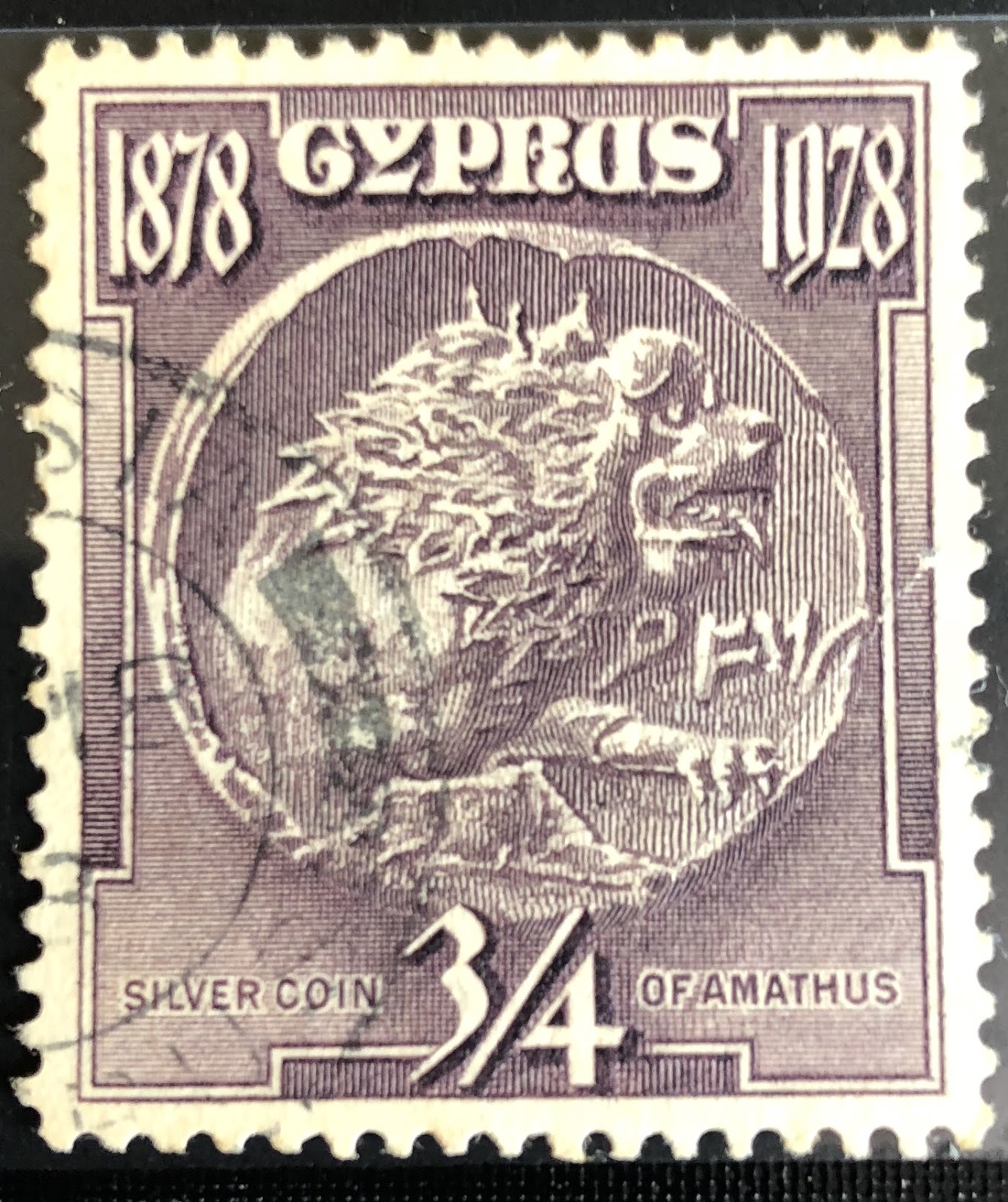
This is oldest stamp in my “Money on stamps” collection Cyprus ¾ Cypriot piastre stamp issued on February 1st 1928. This stamp is lowest face value and part of set of 10 stamps. Usually I go for mint stamps but average sale value of this set is bit on a high side so for now I have to put up with this nice used example 😁

As mentioned stamp is a part of 10 stamps set issued to commemorate 50 years of British rule of Cyprus, recess printed on watermarked paper, perforation 12. It depicts silver Coin of Amathus. Amathus was one of ancient royal cities of Cyprus and coin has a head of roaring lion, which was city emblem, both sides (it was common practice for this type of coins)

Now something bit more modern and to pay my respects for blog owner 😉 

On April 26th 2012 Macedonia issued stamp to commemorate 20 years of monetary independence. Stamp has a face value of 50 Macedonian denars and features 1 denar coin and an ancient Byzantine M type coin (picture is not sharp enough to try to attribute it properly and showing only avers so it will remain partial mystery).   

Macedonia declared its independence from Yugoslavia on 8 September 1991, shortly after, on 26th April 1992 the national bank was established and the denar was declared as official currency, few days after first issue of emergency banknotes was put into circulation (these were more like money coupons), in 1993 Macedonia issued first permanent banknotes.


We are all pretty aware of money importance in our daily life, and while it is true you can’t buy happiness but one can’t deny influence money has on every single person living in modern society. 

Changes in monetary system of any country are kind of very important events but forming of monetary union among multiple countries is epic event with tremendous impact on every country involved. 

Everyone would agree that forming European Monetary Union and common Euro currency was event of century. All countries involved recognized importance and many of them issued stamps commemorating Euro currency.


One of my favorite sets was definitive stamps set issued by Vatican in 2004 consisting of whooping 15 stamps. Each of stamps features one European Monetary Union country flag in background and Euro coin design from corresponding country.


Those stamps remind me of UN series issue that has been issued for a quite few years now, so called flags and coins series. It would be too much to display all of it here but just two pics to show off 😃


Even some non EU countries issued stamps featuring Euro currency, like my country (Bosnia and Herzegovina). 


Speaking of my country I decided to share two more issues also money related ofc.

First, there is this set of three definitive stamps issued in  2002 featuring coins of Bosnian medieval rulers king Tvrtko (0.20 face value), Stjepan Tomaš (0.30 face value) and Stjepan Tomašević (0.50 face value), Stjepan Tomašević was also last sovereign ruler of Bosnia before Otoman empire invaded and occupied country in 1463.


And for the end MS issued by Bosnia And Herzegovina but this time Croat Administration (yes, we have three different and independent postal administrations, each one with its own territory and stamps of each are valid for postage only at corresponding post offices)

MS consists of four stamps with two different designs (two stamps of each design), I personally like design of stamps and a fact they are embossed gives them some luxury appearance, and a price of 20 Bosnian marks for a MS is quite luxury if I can notice (equivalent of 10 euro)😒

Stamps feature ancient Daorson coins. Daorson was a capitol of Daorsi tribe. Daorsi were Hellenised  Illyrian tribe. They adopted Greek language and a lot of their culture. They were quite influential tribe in area of river Neretva valley, possessed their own money (as shown on stamps) and quite powerful navy for that period. They left lot of archeological traces throughout Neretva  valley.


So that was all for today, bet you are exhausted now and I’ll let you go and enjoy rest of this Sunday. Maybe I’ll write sometimes again if Ana finds this was up to her strict standards.

And not to forget for some more interesting M-posts, well you know the drill, click on the following link - Sunday Stamps
 

Sincarely,
 

Danijel