Showing posts with label Cultural Heritage. Show all posts

Sunday, February 2, 2014

Cultural Heritage, Macedonia

Hello Sunday Stampers! For today's episode we have the theme of folk-art...and if at first it all seemed easy peasy, in the end I realized I was stuck with what folk-art actually is...I mean, I know what the definition is and all, but where is the line drawn between folk-art and folklore...or folk-art and museum artifacts lets say...or do they overlap sometimes? what is what actually? As ignorant and ridiculous it may sound, I must admit I got stuck!
So with the potential to have totally gone wrong with my choices today, I still hope you will at least like the stamps =)

I have these three different issues, all representing Macedonian Cultural Heritage.

First we have four stamps issued in 2000, representing antique jewelry, in particular, from left to right, at the top, the 10 denar stamp shows a Bracelet from the 20th century from the region of Bitola (a Macedonian town), while the 5 denar stamp next to it shows a Pin with an Icon from the 19th century from the Ohrid region.
Below, the 30 denar stamp shows the Butterfly Brooch from the 19-20th century from the Bitola region, while the 20 denar stamp next to it shows 18th century Earrings from the Ohrid region.
Out of all these, the most famous one is the filigree butterfly...you can see it in all sizes sold around, sold either as a piece of jewelry or as an ornament to keep at home.


In the Christian religion, the metamorphosis a butterfly undergoes is symbolic of the spiritual evolution all Christians go through. In ancient mythology, the butterfly stands for wisdom and everlasting knowledge, while as a part of the jewelry dates back to the end of the 19 th century. It has been made according to the traditional Macedonian brooch and represents the most exquisite filigree work by the Ohrid Handicraftsmen School from the end of the 19 th and the beginning of the 20 th century. It has been made in a hard technique of filigree work, spinning round several thin handmade silver stripes into one remarkable whole. This kind of manufacture could be afforded only by the masters, wealthy tradesmen and other rich people from that period.


The FDC below shows two more pieces of jewelry...golden earrings with doves dating back from the II century B.C from the village of Marvinci, and а lion-head earring, dating from IV century B.C from the region of Demir Hisar.


And something a bit different...and FDC showing some textile, often used as a pattern for carpets or rugs as shown here. You can often see these in the houses in the rural areas especially.


well, that would be my contribution for today...again, sorry if I went somewhat astray with the topic :)

for more folk-art, click here:
Sunday, May 22, 2011

Handicrafts, Macedonia

I guess Im lucky that Viridian has chosen Sunday as a day for featuring stamps coz it seems to be the only day of the week when I can dedicate some time to it.
This week's theme are handicrafts....being that Macedonia is rich in these, and there are also a number of stamps issued featuring handicrafts, I decided to dedicate this post to my country again....and will save the other nations' handicraft stamps for some post in the future.

Ive chosen two sets of stamps for today....the first one is actually a definitive issued in 2007, representing a traditional woven bag from the 20th century from the Skopje region


this is one of the typical designs that can be seen on the Macedonian traditional clothes as well as tapestries, carpets, bed-covers, curtains and other household items used in the Macedonian rural and urban houses. Each Macedonian region has its unique designs but in general they are all rich in colours and ornamental details.
This kind of bag is something which people used to put bread loaves and cheese and maybe peppers inside when they went on the pasture fields and had to stay there all day...or by school children who had to travel many many kilometres in order to get to their school. These kind of bags have often been described in the traditional Macedonian legends and stories and to those familiar with them and the Macedonian people and culture in general, they bring an image of a freshly baked bread, perfectly hot, where the cheese is put inside between two slices and melts...a very simple but delicious meal for many.
Recently I went to the Night of the Museums event...well, sadly it only took place at one museum, but something is better than nothing. And the museum has this permanent exhibit of ethnological items among which these kind of bags are portrayed too....I have to say I loved that part, showing so many different traditional clothes and accessories, coming from different regions in Macedonia.

The stamps has a face value of 12 denars, comb perforation and comes in a sheet of 25 stamps. The offset printing technique has been used. And what I like about it is its size...it is rather small (28x25 mm) and fits very well on postcards among other additional stamps (coz this one is not enough for postage).

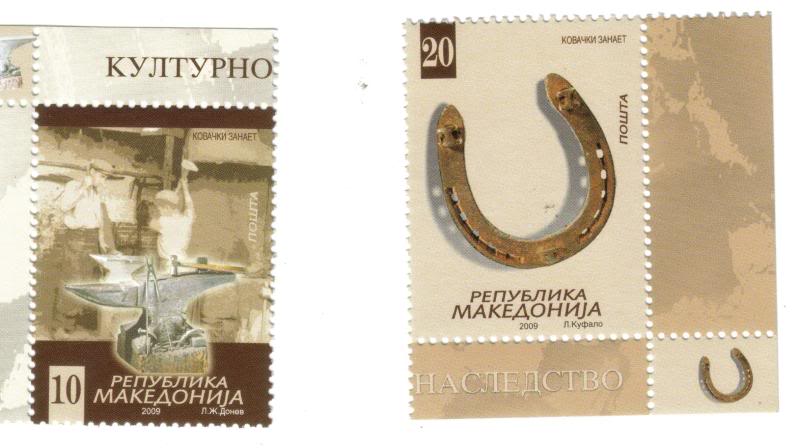
The other set of stamps I chose for today was issued in 2009 and consists of two stamps, under the Cultural Heritage subject:


the 10 denars stamp (the one on the left) depicts an anvil....it is something that is still used today by the craftsmen, blacksmiths in particular...even though as a walk of life it may be disappearing, if you walk around the Old Bazaar in Skopje, for example, you will come across old small blacksmiths' workshops. From what Ive heard, a craftsmen chamber has been established in Macedonia, which offers help and support to the craftsmen people.
Here is one video, which unfortunately is in Macedonian, but it is a nice example to see what I was talking about...the video has been taken in the Old Bazaar in the blacksmith street, where years ago it was full of blacksmith's workshops...nowadays, the remaining people who still perform these activities complain how the modern industry simply destroys the crafts and how they only work for little money and that young people nowadays are totally disinterested in these so-called, old-fashioned activities.

http://www.makdenes.org/video/4654.html

the second stamp of a 20 denars face-value represents a horse-shoe. I dont know if this belief is present in other cultures as well, but here in Macedonia it is believed that if one hangs a horse-shoe on the wall in the house, that should bring luck to that family or that they will protect you from the evil spirits and goblins :)
The open part of the horseshoe should look downwards according to its position in the horse....so as the horse runs forwards, so the fortune should go forwards inside the house.

the size of both of these stamps is 40.2x30.2mm, offset printing technique in a sheet of 9 stamps. When used together, both stamps are postage-perfect for postcards.  

well, sorry for the longish post...I hope you werent bored :) For more crafty posts please visit Viridian's blog...just click on the button below:

Sunday, March 7, 2010

Zofia Bosniaková (1609-1644), Slovakia

A very nice cover decorated with a nice s/s and two small definitives.


Both, the s/s and the small stamp were issued in 2009.
The s/s was issued to commemorate the life of Zofia Bosniaková, who during her life was well-known for her help she gave to the poor and sick and other good deeds. She died at the age of 35 and it is said that her body, almost undamaged, was found 45 years after her death in the castle crypt, despite the fact that it hadn't been embalmed.
The small stamp is from a set of 12 definitives depicting the Cultural Heritage of Slovakia, and this one shows The Church of St John the Baptist in Sedmerovec - Pominovce.

Thanks a lot to Milos for this really beautiful cover.