Sunday, May 13, 2018

It is an M day!


Good afternoon folks, it is a Sunday and a day for new post here at myphilatelicpassion.blogspot.ba. First of all want to say thx to Ana for letting me use her blog and (ab)use her faithful followers.
It is an M day and I would like to introduce you to my unusual stamps collecting topic. There are a lot of people collecting stamps on topics like birds, cats, dogs, art, religion, lighthouses, Olympics etc. You could try to guess and say I collect motors and would be still wrong.

They say stamps are like small ambassadors of their countries but there is one thing older and even more ambassador of one’s country.  As the song says Money, money, money must be funny and for me if money is on stamp it is double funny 😀

Collecting coins and banknotes often goes hand in a hand with collecting stamps and I have been collecting both for quite a while when I came upon idea of collecting this particular topic. Will give it a try display few items and who knows maybe someone finds it interesting enough to start collection of their own.
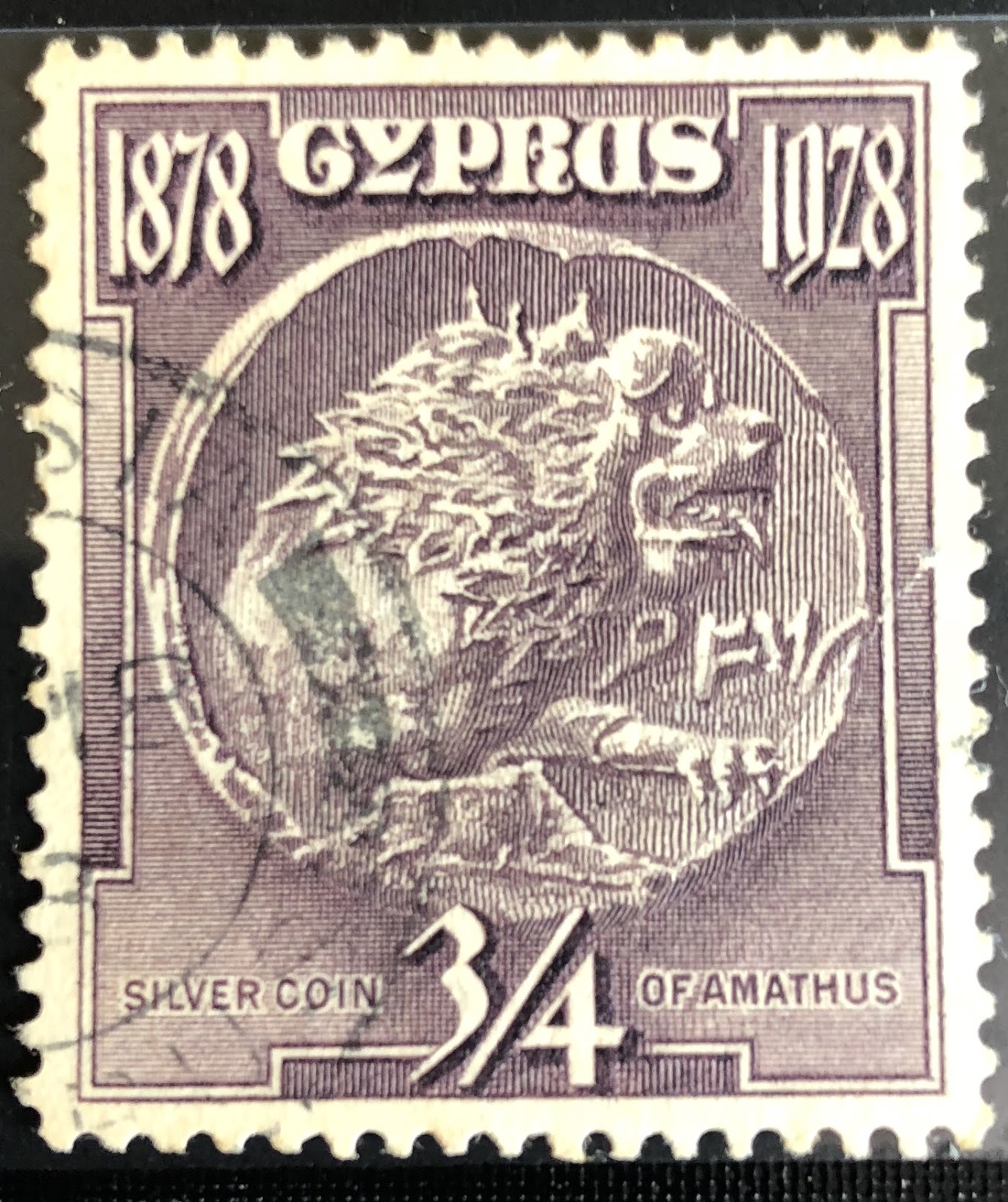


This is oldest stamp in my “Money on stamps” collection Cyprus ¾ Cypriot piastre stamp issued on February 1st 1928. This stamp is lowest face value and part of set of 10 stamps. Usually I go for mint stamps but average sale value of this set is bit on a high side so for now I have to put up with this nice used example 😁

As mentioned stamp is a part of 10 stamps set issued to commemorate 50 years of British rule of Cyprus, recess printed on watermarked paper, perforation 12. It depicts silver Coin of Amathus. Amathus was one of ancient royal cities of Cyprus and coin has a head of roaring lion, which was city emblem, both sides (it was common practice for this type of coins)

Now something bit more modern and to pay my respects for blog owner 😉 

On April 26th 2012 Macedonia issued stamp to commemorate 20 years of monetary independence. Stamp has a face value of 50 Macedonian denars and features 1 denar coin and an ancient Byzantine M type coin (picture is not sharp enough to try to attribute it properly and showing only avers so it will remain partial mystery).   

Macedonia declared its independence from Yugoslavia on 8 September 1991, shortly after, on 26th April 1992 the national bank was established and the denar was declared as official currency, few days after first issue of emergency banknotes was put into circulation (these were more like money coupons), in 1993 Macedonia issued first permanent banknotes.


We are all pretty aware of money importance in our daily life, and while it is true you can’t buy happiness but one can’t deny influence money has on every single person living in modern society. 

Changes in monetary system of any country are kind of very important events but forming of monetary union among multiple countries is epic event with tremendous impact on every country involved. 

Everyone would agree that forming European Monetary Union and common Euro currency was event of century. All countries involved recognized importance and many of them issued stamps commemorating Euro currency.


One of my favorite sets was definitive stamps set issued by Vatican in 2004 consisting of whooping 15 stamps. Each of stamps features one European Monetary Union country flag in background and Euro coin design from corresponding country.


Those stamps remind me of UN series issue that has been issued for a quite few years now, so called flags and coins series. It would be too much to display all of it here but just two pics to show off 😃


Even some non EU countries issued stamps featuring Euro currency, like my country (Bosnia and Herzegovina). 


Speaking of my country I decided to share two more issues also money related ofc.

First, there is this set of three definitive stamps issued in  2002 featuring coins of Bosnian medieval rulers king Tvrtko (0.20 face value), Stjepan Tomaš (0.30 face value) and Stjepan Tomašević (0.50 face value), Stjepan Tomašević was also last sovereign ruler of Bosnia before Otoman empire invaded and occupied country in 1463.


And for the end MS issued by Bosnia And Herzegovina but this time Croat Administration (yes, we have three different and independent postal administrations, each one with its own territory and stamps of each are valid for postage only at corresponding post offices)

MS consists of four stamps with two different designs (two stamps of each design), I personally like design of stamps and a fact they are embossed gives them some luxury appearance, and a price of 20 Bosnian marks for a MS is quite luxury if I can notice (equivalent of 10 euro)😒

Stamps feature ancient Daorson coins. Daorson was a capitol of Daorsi tribe. Daorsi were Hellenised  Illyrian tribe. They adopted Greek language and a lot of their culture. They were quite influential tribe in area of river Neretva valley, possessed their own money (as shown on stamps) and quite powerful navy for that period. They left lot of archeological traces throughout Neretva  valley.


So that was all for today, bet you are exhausted now and I’ll let you go and enjoy rest of this Sunday. Maybe I’ll write sometimes again if Ana finds this was up to her strict standards.

And not to forget for some more interesting M-posts, well you know the drill, click on the following link - Sunday Stamps
 

Sincarely,
 

Danijel

Sunday, May 6, 2018

The 100th Anniversary of the Inauguration of Constanta Harbour, Romania

If I wasn't as lazy as I am right now, I probably would have been more inventive with the L letter, but unfortunately I am, so I would just go with the first thing that crossed my mind, which, oh so surprisingly are lighthouses ;-D  Well, it is just one but it is still a lighthouse


On 23 December, the Romanian post issued this lovely set of two stamps, commemorating the 100th Anniversary of the Inauguration of Constanta Harbour.
The first stamp shows the sailing ship Mircea, while the second one, the Constanta Regele Carol (King Carol) I lighthouse.


The Constanța Harbour is located in Constanța, Romania, on the western coast of the Black Sea, and is the largest Port on the Black Sea and the 17 th largest in Europe. The favourable geographical position and its importance are emphasized by the connection with two Pan-European transport corridors: Corridor VII – Danube (inland waterway) and Corridor IV (railway).


The lighthouse featured on this stamp was dedicated to honor King Carol I, who died in 1914. It is known locally simply as the farul vechi (the old lighthouse) and it has been inactive since 1961.

well, that was quite short :)

For some more interesting L-posts, well you know the drill, click on the following link - Sunday Stamps

Sunday, April 22, 2018

Celebrity Chefs, USA

Good Day Sunday Stampers, and welcome to the J edition of our second A-Z round!

I know the title may be misleading, but this is indeed a J-related post since out of the 5 people featured here, 3 of them bear a name that starts with J so, here we go :)


On September 26th, the USPS issued 5 stamps honoring five chefs who are said to have revolutionized the nation’s understanding of food. By integrating international ingredients and recipes with American cooking techniques and influence, these chefs introduced new foods and flavors to the American culture.

The chefs featured here are:

Joyce Chen - (1917–1994) is one of America’s most well-known promoters of Chinese food. From her landmark restaurant in the Boston area to her cookbooks and trailblazing PBS television show, Chen invited newcomers to sample unfamiliar dishes in ways that firmly established Chinese cuisine in the United States.

James Beard - (1903–1985) laid the groundwork for the food revolution that has put America at the forefront of global gastronomy. He was a pioneer foodie, host of the first food program on the fledgling medium of television in 1946, the first to suspect that classic American culinary traditions might cohere into a national cuisine, and an early champion of local products and markets. Beard nurtured a generation of American chefs and cookbook authors who have changed the way we eat.

Julia Child - (1912–2004), demystified French cuisine for a U.S. audience. Through her extremely popular television shows and cookbooks, Child showed us that we could make even complicated dishes in our very own kitchens, doing so with a joie de vivre that made her the public face of American cooking for more than 40 years.

Edna Lewis - (1916–2006) - Known as “the Grande Dame of Southern Cooking,” Edna found wisdom in the customs and patterns of her rural Virginia childhood. By bringing such quintessential dishes as shrimp and grits or roast chicken to the plates of fine restaurants, Lewis convinced her fellow Americans to take a second look at Southern cooking while also serving as one of the first voices to reemphasize the importance of fresh, seasonal ingredients.

Felipe Rojas-Lombardi - (1946–1991) Renowned for his creativity and culinary adventurousness,, Felipe is widely credited with introducing the Spanish small-plate tapas concept to American restaurants while raising the profile of Caribbean and South American cuisine.

*** information taken from the USPS website.

As a foodie, I have to say I find these stamps really interesting since I especially like trying out interesting and unusual foods (as long as it is not something alive or is meat, with some exceptions). I especially have a soft spot for desserts (my FB friends know what I am talking about :D)

Can't say I have a favourite cuisine, but for sure I love Chinese, Italian, Turkish and Mexican stuff.

How about you? Any favourite cuisine or food? :)

For more J-stamps, visit today's edition of Sunday Stamps :)


Sunday, April 8, 2018

Horoscope, Bosnia and Herzegovina

After a lovey half-day trip out in the nature, back home to spend a cozy evening and do my contribution for today's Sunday stamps... and before I get down to the stamps, just wanted to show you these pictures from today's trip, in case you need an idea for your next travel destination ;)

(you can read a bit more here: Kozjak Lake)


and now to why you are actually here, and that is stamps.
Now even though I am one of those people who do not believe in horoscopes, I find it that sometimes stamps related to astrology are quite nice actually, just like this fantastic issue from BiH, which I decided to share with you today, issued on 26th January 2004, in a set of, well of course, 12 stamps.

Regarding my relationship to astrology... it has not always been that way. In fact, when I was little I was actually hooked on it, to an extent probably not considered healthy for a 12 year old, but I guess I got that from my aunt, since I spent a lot of time back then with her and my grandparents and she was all into these chakras and third eyes and all those astral and paranormal stuff, while I was regularly buying and reading astrology related magazines. Looking back at it, not a wise way to spend money, but I can find something of this kind about each period of my life... cos of course at the time being, it doesn't look unwise at all :))


So according to these stamps, my element is FIRE and my planet is The SUN (well I do enjoy sitting outside in the sunshine, when it is not too hot, preferably in silence).
Body area: spine, back, heart (ok, if this means that I would be suffering from back pains, then I give you credit for this one).
Colors: gold, orchard (if there is something I absolutely dislike, are things made of gold)
And it says I am: assertive, confident, social, expressive, leader, courageous, competitive, creative, emotional, adventurous, determined, dedicated, energetic, preserving and adaptable (that is 5 out of 15 right :D)
And the negative stuff: arrogant, egotistical, bossy, temperamental, very jealous and possessive, extravagant and insensitive (I don't dare be judgmental on this one, I'll let others do their assessment :P)

Anyways, reading a horoscope can always be fun at least and have a good joke coming out of it. Do you believe in horoscopes? Do you find it true what is said about you?

For more H entries, visit today's edition of Sunday Stamps.


Sunday, April 1, 2018

Native Glowworms, New Zealand

Well, before anything I would like to wish Happy Easter to everyone celebrating it today (Here in Macedonia we shall have Easter next week, in accordance with the Orthodox Calendar...)

But instead of Easter stamps, today we shall follow the regular alphabet and so far we have reached the letter G in the second round, which brings me to this New Zealandian issue of Glowworms.

Due to the colours, it is probably a bit difficult to distinguish, what's what, but what we have here first is the FDC, and later you can see the Presentation Pack for this issue.


Despite what the name suggests, glowworms aren’t true worms - they’re the larval stage of the fungus gnat. The fungus gnat can glow at all stages of its life (except in the egg stage), but it’s during the larval stage that it shines the brightest. The famous blue-green ‘glow’ is a chemical reaction created in what is the glowworm equivalent of the human kidney. The total life cycle of the fungus gnat takes around 11 months, with the glowworm stage being the longest in the life cycle, averaging around nine months. The New Zealand native glowworm is scientifically known as Arachnocampa luminosa, and although it is most spectacular when seen in caves, it’s common outside caves too, favouring damp, warm conditions with a good supply of food.


The four stamps in the collection feature glowworms from locations across New Zealand – including Ruakuri Cave in Waitomo and within the presentation pack one can read detailed information regarding the life cycle, as well as information regarding each of the glowworms' caves featured.


- 80 c -Mangawhitikau Cave, described by Sir David Attenborough as “astonishing”, is famous for its extensive display of glowworms. Tours depart from the Spellbound office located in the Waitomo Caves village and artificial lights are kept out during the tours so the glowworms can be viewed in their full glory.

- $1.40 - Nikau Cave is located in Waikaretu, a sheep and cattle farming area approximately 90 minutes' drive southwest of Auckland. This delightful tourist cave was known to Māori and early settlers. Privately owned, the cave has no paths, handrails or lights. Tourists take torches and clamber up a streambed beneath stalactites, shawls and delicate straws.

 - $2.00 - Ruakurī was the ‘wildest’ of the early Waitomo tourist caves – with hidden waterfalls, ‘a ghost walk’, galleries and decorated chambers. It was named for the wild dogs (kurī) that lived in the cave entrance, which was used by Māori long before Europeans arrived.

 - $2.50 - The Waipū Caves are in a scenic reserve about 10 kilometres inland from the little boutique village of Waipū. They were first used as tourist caves in the 1870s, a decade before Waitomo Caves, when tourists were transported by horse and buggy.

Unfortunately, the actual glowing cannot be seen on the stamps here (but the actual stamps do glow in the dark after being exposed to light), but if you ever have or have had the chance to visit one of these caves, do share the experience :)

For more G stamps, follow this link :)